Reinhabiting the Body

There are moments in clinical practice when words are no longer enough.

When a client can speak their experience with clarity, yet something essential remains untouched. When insight is present, but the body does not shift. These are often the places where the nervous system is still holding what language cannot yet reach.

Reinhabiting the Body offers a different entry point.

This on-demand training introduces a Polyvagal-informed, movement-based approach to working with trauma and dysregulation beyond verbal processing. Rooted in embodied practice, it supports clinicians in attuning to the body’s subtle cues and working directly with the rhythms, patterns, and protective responses that shape experience beneath narrative.

You will be guided to:

  • Recognize non-verbal expressions of autonomic states through breath, posture, rhythm, and movement
  • Support state shifts using simple, accessible somatic and movement-based practices
  • Work with empathy, attunement, and co-regulation as embodied relational processes
  • Restore interoceptive awareness and a sense of safety within the body
  • Tend to your own embodied resilience as a practitioner

No prior movement or dance experience is needed—only a willingness to listen to what the body already knows.

This training is suitable for therapists, practitioners, and anyone interested in embodied approaches to healing.

Format: On-demand video course
Access: Available immediately upon registration (1–3 year access options)
CPD Hours: 6
Price: $175.00 USD

PURCHASE THE COURSE

Somatic Healing Summit

This recording captures Amber Elizabeth Gray’s contribution to the Somatic Healing Summit, a 6-day immersive exploration into the intelligence and wisdom of the body. Originally created as a live event, the Summit brought together leading somatic practitioners, teachers, and healers whose work illuminates how transformation begins within.

Across this session, Amber offers her uniquely grounded approach to Polyvagal-Informed Dance Movement Therapy (PVDMT), inviting viewers into practices that reconnect breath, rhythm, and embodied presence. Her teaching explores how the body holds stories of resilience and survival, and how movement and somatic awareness can awaken our innate capacity for restoration.

This recording is an invitation to slow down, listen deeply, and return to the place where healing becomes possible: the body that is already yours.

Come home to your body. Return to yourself. The journey begins here.

Somatic Healing Summit Recording

The Democratic Body

The Brilliant Body Podcast – 50th Episode Panel Celebration

In this special 50th episode of The Brilliant Body Podcast, host Ali invites three previous guests – Sarah Peyton, Rachel Fell, and Amber Gray – to join in a first-ever panel discussion. Each guest brings decades of experience in somatic education, neuroscience, neurodivergence, and trauma healing across diverse cultures and communities.

Together, they dive into the deep connections between body intelligence and democracy, unpacking how embodiment influences everything from individual healing to collective social structures. From reclaiming the intelligence of the body to exploring how dissociation impacts global citizenship, the conversation weaves personal insight with profound societal reflection.
Whether you’re new to somatic awareness or deeply rooted in body-based practices, this episode promises to challenge, inspire, and expand your understanding of what it means to live as a “brilliant body” in today’s world.

Listen Here

on stewardship

September 2025~

The word stewardship expanded in meaning for me when my father-in-law died suddenly. Because he is buried in a military cemetery, the writing on his stone was limited to a few words. As the family contemplated how to honor his life, I reflected on a visit to his ancestral lands and village in Norway my husband and I took many years before. We found the village his family immigrated from and learned the meaning of the names his ancestors came across the Atlantic with, names that reflected place and history. One of them, Volkvarrson was forcibly changed, as so many names were, at Ellis Island. Removing names that reflect legacy is erasure, and I believed it was important to find a way to reclaim the meaning to honor my father-in-law. Our understanding of the meaning of this name is both a family name (“son of”) and it refers to someone who tends to, stewards, the people. This is ultimately what landed on my father-in-law’s stone, because he embodied that throughout his life.

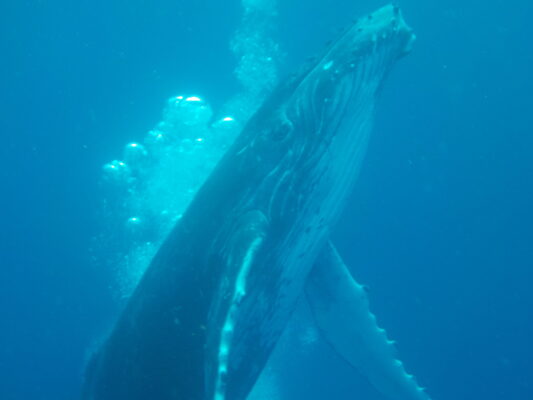
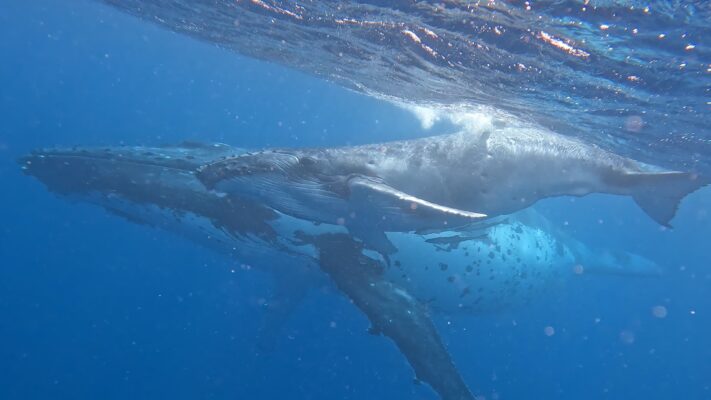
The ideas and actions of stewardship have been an ongoing inquiry for me ever since. I just returned from my annual Dancing the Wild Home Body of Change eco-somatic retreats. I’ve spent a month living on a remote island that is truly in the middle of the South Pacific, surrounded by waters that range in color from azure to teal to seafoam to olive to cobalt to navy. There are uninhabited islands all around, known locally as “whale bone island” or “coconut island.” The inky sky has many more stars than the night sky back home, and the Milky Way is an endless gossamer trail. Breaching, logging, spouting, and tail slapping whales are present for 360 degrees. We rely on solar power and a generator to get a few hours of internet a week. We shower with camping style solar showers. Not so long ago there was no cell service. While the number of bars in our phones are increasing, it’s still delightfully hard to get a signal.

Guests sign an agreement of stewardship: of cleaning up their locally styled accommodation and the beaches. Of preserving water. Of respecting the small but dense wilderness living on this tiny spit of an island surrounded by big blue love. This living in real time, with the sun, with dark skies graced with a still fully visible Milky Way, the constant sound of ocean, wave, wind, seems utterly usual to me. We live so close to earth and ocean that these rhythms, which are our origin rhythms, offer a constant source of connection to the ocean embraced land we are on. I observe retreat participants initially struggle with the slowed down rhythm so intimately connected to the natural world, with the loss of tech and AI driven speedy communication and then begin to dissolve the tensions and demands of these made-up societal rhythms for the completely natural one surrounding and holding us. Rhythms of listening, inquiry and reflection. It becomes impossible to forget our role as stewards of everything that breathes, moves and lives in the environment that so intimately contains us. This reconnection and reclamation into place ushers acceptance of the responsibility of stewardship is the reason for Dancing the Wild Home, and it is an antidote to the utter insanity of the contrived world so many of us live in.

People traveling this far to swim with whales soon learn that it’s not a “sport,” it’s an engagement in a deeper rhythmic relationship that exists in whale time. The whales choose who and when they interact. We practice Continuum, a brilliant moving practice created by Emilie Conrad whose words from her book Life on Land best describe both the purpose and the practice of the work:

“The concert of existence places me in resonance with our biosphere — meaning that at this moment there is no “body,” no separation; I am part of the swirl of bio-morphic unfolding. I feel my breath as one with my world. I am not bound by culture or language. The deepening of sensation allows me to be without category. I transfer the moisture of my cells, join the wet of the grass, the pour of the ocean, the stars that watch over the night. The plants breathe, my skin is wet, we are here. This fundamental umbilical to life without category is for me the first stage of sanity.”

I share a few simple and profound “rules” we all must agree to promote the possibility that everyone joining the retreat embodies stewardship. We never approach the whales, despite the temptation each of us naturally wrestles with when they swim close, gazing into our eyes, extending a pec fin, rolling their bellies upwards towards us like puppies. It’s magic enough to be immersed in the wild shades of ocean, tasting and sensing saltwater on our skin, witnessing our marine mammal kin in their home, open heartedly welcoming us in. We clean the beach of all garbage we find. I collect plastics in an empty duffel to return to a place it will be recycled. Our locally crafted fales often house spiders, geckos and other inhabitants of this island. We learn to identify their night songs so we can just return to sleep when we hear them near us. We coax them along when they take up residence on a blanket or towel or drinking glass. None of them will hurt us, so we don’t injure or destroy them. We all carefully check the beautiful shells we find to be sure no one is living in it. The island is full of hermit crabs whose homes are a panoply of spirals, cylinders, circles, colors, and sacred geometry, from palest blush to bold red and sparkly bronze. One previous participant who coveted a uniquely bright red shell googled how to invite a hermit crab to relocate to another shell if you really want his or her shell. Removing animals from their shells in all the cruel ways humans do it is violence. She tried as researched, by providing two larger options. Those shells were quickly occupied by two other hermit crabs whose shells were too small, and the one she wanted remained in its elegant and vibrantly red shell. She watched them all crawl across the sand to their respective beachfront “property”, willingly letting go of her desire to possess the shell, celebrating the new homes she helped two other crabs find. This respectful act is stewardship.

Stewardship exists in these tiny gestures. We have so much work to do to restore the balance that once existed in our relationship with the natural world that sustains our own life. It can be overwhelming, especially as climate crisis looms, already changing our temperatures, landscapes, and seasons. To engage as earth steward and preserve our energy for caring and tending, and our commitment so that we can keep going, we can begin here, anywhere, with the smallest action.

on remembering a wonderful father

August 2025~

My Father, Charles F. Gray III, died 4 years ago today, August 26th. I am always in the South Pacific this time of year, with the ocean and the humpbacks, but the pandemic made this impossible from 2020-2022. This was a blessing; I was with him in the hours before he flew and was able to ease him towards a letting go he struggled with. My Mother died two months prior, after tending to him for the 6 years he descended into the isolated world of dementia and Parkinson’s disease. He was first placed in skilled care in 2015 when he began falling and became confused about where he was and who he was with. He never forgot us, his family, but he began to scramble time and place. He also suffered from congestive heart failure and his medical team warned us several times before his death that he was likely “very close.”  

My Mother longed to outlive him. She was all levels exhausted from caretaking him, and the rollercoaster path of his decline and descent towards leaving the world exacerbated her congestive heart failure to an extent that she died first. We, his family and even his medical team, think he may have forged on for a few more years had he not been infected with the COVID delta variant. When he finally died, he died quickly.

I am writing this on the anniversary of his death while watching the streams of blues and greens that color the ocean here. Every now and then a whale blows or breaches near the soft horizon. When I first returned here in 2023, post pandemic, I carried “parting stones”, made from my parent’s cremains, with me. I offered them to the big blue love of ocean here, near a humpback “nursery” where mothers and babies were congregating and singing. It was within an hour of that offering that I “met” the 50-ton male escort eye-to-eye I wrote about in an earlier blog. It is rare for escorts to interact in this way; usually the moms and babes engage with the tiny humans bobbing about in their home. Our whale guide, a Tongan man who grew up with these magnificent wisdom carriers, looked at me when I returned to the boat and simply said “You were just blessed. He came to let you know your parents are ok. This is a very special interaction.”

In 2024, last year, I woke up on August 26th to a windy, rainy, dark gray day, and was on the verge of declining a space on the boat when I sensed my dad’s adventurous, wild Spirit. I knew if he were here, which he often wished he could be, he would say “let’s just go. It will be an adventure”. Before we left I invited him to offer me a sign of his presence. Mid-day, when I was swimming alongside a mother whale and her baby, a 6.9 earthquake rocked the ocean floor (and apparently all the surrounding islands).  We were only 20 miles from the epicenter and the shearing of the earth made a sound, amplified by our watery environment, I will never forget. The ocean bed splitting and reshaping. The whales were gone in a flash, diving down with a strength and a swiftness I had never seen. Six whales breached all around the boat. When I realized what was happening, while the others swam to the boat, I dove down a little deeper, knowing this was likely the only time I would hear an earthquake under the ocean’s surface. My Dad would have done the same.

My parents are a primary reason for my annual retreats here. A friend introduced me to a whale guide in 2015 because she knew my love of whales, and Continuum, and saw the obvious connection between the two. When I watched a few videos of the whale swims, I knew I wanted to experience this. I first dreamed of whales when I was a teenager, and in the dream, my father and I were climbing bleachers on the pacific coast of the United States looking for a way out. He was growing older as we went up and down the endless bleachers. I realized he was withering, dying before my eyes. Feeling despair, I looked at the Pacific Ocean and four whales appeared, swimming in synchrony, their tails above the surface. I settled into my bones and knew it was going to be ok. When I awoke, and inscribed the dream, I realized I was going to be ok when my father, who I was very close to, left this world. I felt compassion from the whales. 

Around 40 years later, my father’s first stay in skilled care was the winter of 2015. Having been warned he may decline quickly, I flew to him, and spent time with him, sorting through memories, and sharing little bits of dreams and news to help him connect to the here and now, and to me. His thinking, speaking and presence were garbled. He was always confused. When I showed him a video of the guide and the whales, he was mesmerized. We watched it over and over, and I told him I dreamed of doing this. He knew my love of whales, having bought me more than a few plush whales and whale watches and jewelry. In a moment of sudden crystal-clear lucidity, he said “Where do you have to go to do this?” I told him. He said, “When can you go?” I said “It’s in August. I’d like to go this year, but the flights are already too expensive, so I hope to go next year.” He paused, his eyes suddenly deeply thoughtful, looking straight into mine. I recognized this gaze. It’s the gaze of a father who loves his daughter expansively and unconditionally. His eyes reflected a witnessing, a being seen, that arises from the deepest bond of pure love. My father was, and is, the one person who understands me at a core, cellular, spirit level. He said: “If you really want to go, I will buy your plane ticket. But you must promise me one thing.” I asked him what that was. “Promise me you will listen to the whales and never stop listening. Sweetie, you have been waiting for this your whole life. If you promise to always listen, I will help you get to the whales.”

Thank you, Dad. I often hear your wisdom when I hear the whales breathe. And I am still listening.

Free Resource: Cultivate A New Relationship With Your Ancestors

Reclaim connection. Honor memory.

Sign up below to receive A Guide to Cultivating New Relationships with Ancestors — a free, gentle invitation to pause, reflect, and reconnect through embodied practice.

Enter Here to Download Your Free Guide

on witnessing

July 2025~

When I completed my June newsletter blog on repatriation and Ancestral places, I already had a “follow up” idea for this newsletter, about movement and migration. That idea is going to wait. Having recently returned from visiting the land I wrote about in June, and witnessing the transformation already occurring there where nine acres of native pollinator meadow is just beginning to grow, I have been even more attuned to the magic and movement of the natural world around me. Always a lover of wildlife and still wild spaces, I, like many of us, can get so busy I forget to appreciate the beautiful world that is an extension of us. One of the last things my Mother said to me as she was dying, when sharing what she loved about who I had become, was “The animals. You have always loved the animals and the wild ones. I love how you take care of them now. They are your children.”

Preparation warning: there are some gruesome details in this blog. When we are willing to witness, and to act, we don’t always get to choose what we will see. Four days ago, I witnessed the brutal death of a sweet wild rabbit who found herself trapped in between the four lanes of one of Santa Fe’s busiest roads. The road is near a bike path and a green area, so I can only guess that’s how she got to this precarious and final moment in her life. I have spent 4 days processing what I witnessed so soon after being amongst the flowers and numerous mama and baby bunny families.

I pulled into the parking lot where we buy Colorado peaches and as I was getting my wallet, saw the rabbit in the middle of the road. I did a double take because it’s such an unusual sight. The rabbit was hopping frantically back and forth in the middle of the road, unable to get out because of many fast moving cars. It dodged at least 5 in the few seconds it took me to make sense of this and to act.I quickly tossed my wallet back in the car, grabbed my keys and a rescue kit from my trunk. As I started to step into the road, I looked down for a moment to find the towel I had to cover the bunny, to use as a flag so people would stop. When I looked up, the rabbit was flattened. I froze. A woman in a car that was pulling out into the road had seen it, and she stopped. I heard her gasp a NO. Suddenly the rabbit lifted its head and tried to hop, but its leg was severed, skinless, and its back half smashed, oozing blood and guts. It was an awful, heartbreaking sight. I ran out into the road, stopping all traffic with a force I can only describe as embodied righteous anger. I felt clear strength in every bone of my body. I was putting my hands up to stop traffic and yelling NO. STOP. Over and over. Every car did.

When I got to the rabbit it had tried to stop fleeing and was beginning to quiver, the light rapidly leaking from its eyes. I gathered it, guts and all, and held it close, stroking its forehead and singing until it died. I stayed in the middle of the road, on a median, so we could be still while it died. When I walked back to my car, dead bunny in my arms, the woman in the car was still there, tears on her cheeks, watching. She rolled down her window and said “Thank you. It was so hard to watch that truck swerve to hit the rabbit.” I had not seen that and I felt rage surge in me. “What? Was it intentional?” I asked. She replied that it appeared that way, and that is why she was still sitting there. All she said was “it was so hard to watch it get hit.” I still hope that the pickup truck, which I did see before I looked down, just didn’t see her. I recall it was moving fast and I flinched in fear that it would hit her. Whether or not it was going too fast, the driver not paying attention, or did it intentionally which is unconscionable, I was and am pissed off. None of us has the right to be careless or cruel enough to take another life for no reason.

I placed her in my car, and drove her to a forested area where her body, now lifeless, could nourish another life. The next day, I did the same for another rabbit that had only been dead an hour or so.

I share this because I am still heartbroken and I am still angry. I am sure every single one of us has seen many animal bodies squashed in the road, and kept going. It’s easy to get used to it, and go numb. After studying with Pema Chodron, I began doing “Tonglen on the Spot” for every single dead creature I see. I stop and move them off the road, no matter their condition, when it’s safe enough and possible to do so. I create a “memorial service” in my mind and heart, offering them the respect that every life deserves.

It may seem excessive to honor a single rabbit in this way. It’s not. One of the ways I teach Polyvagal-informed somatics is to remind people that our autonomic nervous systems (“ANS”) are a gift of our evolutionary ancestors–the wild ones. We have the ANS we do because of all the species who forged the evolutionary trail behind us. All who made it and also, all who did not. Life is an experiment. We also have a responsibility for carrying this experiment forward, being in service of the pathway of evolution before us. If humans are truly among the “most evolved” species, then our role as stewards for the earth that supports us with food, water, oxygen and PLACE as part of the web of all interconnected living beings should be enough to show respect to our other sentient relatives.

As I write this, I think of the many articles I have read documenting the link between animal cruelty and human violence. I wonder how many animals are ruthlessly killed daily, not for our nourishment and sustenance, but for sport, or due to neglect, abuse, meanness or just not paying attention. And I think of the violence in Haiti, Ukraine, Gaza, Yemen, Florida and ALL the places where human violence contributes to unbearable suffering, today. Now. Every second of every day. Only a few courageous voices have spoken loudly against the genocide of the Palestinian people. I contemplate how ruthless it is to look away, to forget, not to speak truth to power or to act when the suffering is so visible, right in front of us. I don’t know how many cars drove by the terrified rabbit before and after she was hit. Or how many people turn the channel or flip the page when photos of starving, dehydrated children in Gaza appear, or when gang control of Haiti is mentioned at the same time many Haitians in the United States are terrified of losing their immigration status because the U.S. government proclaims it “safe” again. Or when sensationalized images and news of “Alligator Alcatraz” appear, while high powered people joke about alligators eating immigrants. Or forget that Ukrainians still suffer increasing attacks against civilian targets that the news barely covers anymore. Or that most people in Yemen face severe food insecurity and a barely functioning airport.

The day after I witnessed the rabbit’s cruel death, this Lisa Congdon print popped up on my facebook page:

Slowing down to pay greater attention to that which merits our witness and our action does matter. Every single second of every single day.

on repatriation and paternal lineage

June 2025~

I’m writing this as I travel eastward to visit Ancestral lands. My Father’s settler and Indigenous roots are in the central Pennsylvania and Herkimer Valley region of New York. We visit this land annually and recently planted 8 contiguous acres of pollinator wildflower fields to support the monarchs who brave a 3,000-mile migration from Mexico to Canada and the United States. This land is legacy; not owned but stewarded as an extension of our family in the eternal connection of all things. This land came to us through my father-in-law, and it happens to be in the Ancestral region of my own Father. I dreamed it long before I ever walked on it. A recurring dream of wolves and I at the edge of a pine forest and field re-emerged when I first saw this land: it was the same meeting place. This paternal lineage through the land always reminds me of my Father’s strength and wisdom, and of how much I miss the man who understood me better than anyone ever would. I am the apple that fell from his tree.

When I traveled to Australia earlier this year, I repatriated a boomerang. Repatriation means to return something to its homeland, and the boomerang, pictured above, was removed from Australia in the 1960s. It was likely carved in the ’40s or ’50s. It was given to us by a neighbor who was moving and found it when clearing out boxes of “old stuff.” Knowing of my love for Australia, he offered it to me; he otherwise planned to throw it away. We accepted it and knew instantly it was old. It hung on our kitchen wall, and I often mused at its uneven shape. I had only seen the returning boomerangs with their even and balanced shape. I would learn, years later, that this is a hunting boomerang.

Several years later, I was visiting Devils Marbles in the red center of Australia. While in the visitor center, I saw a similar, if not almost the same, boomerang. I mentioned this to the ranger, who was Warumungu, and he graciously and with a bit of understandable agitation asked me why I had it. I explained the story of how it came to us, and he simply said: “You need to bring it home.”

That was 2013. On February 27, 2025, the boomerang returned with me to Australia, with the help of a dear friend who is a proud Yindjibarndi woman and her friend who is a professor of museum anthropology at Deakin University. The boomerang has returned to the grandson of the man who carved it. He gave many such boomerangs to the missionaries who frequented Australia in the ’50s and ’60s. That’s how this one landed in the U.S. They were given in a spirit of reciprocity, not as a gift in the way of Western society but as an act of commitment to ongoing stewardship. The recipients were to care for the gifts and return or gift them onward when they were done. Most of the missionaries simply kept them, and the community mournfully acknowledges that many of those boomerangs likely landed in garbage bins, as this one almost did.

There is healing and reclamation in the act of repatriation, and I feel this standing on the land that my Ancestors walked and breathed and lived on. In these times of unraveling and upheaval in the U.S., when wild places are threatened to be sold off for corporate profit, I often hear my Father’s voice reminding me that I have everything I need inside of me, and that wild places are the most important gift.

Father’s Day came around this year one day after the No Kings protests, the same day as our wedding anniversary. As I approach the 4-year anniversary of my father’s death on August 26, 2025, I recall that the last time I heard his voice was when I sat in this very place and spoke to him by phone. No matter what I said, he just kept repeating, “I love you so much. I love you so very much, Sweetie.” I wonder if his Ancestors, my Ancestors, hear this through the ever-rippling green 100+ acres of wild woods and meadows, now bright with wildflowers and slowly being restored to their native habitat in an act of earthly repatriation.

The last time I took my father out, wheelchairing him from the small room he lived in at an assisted living facility, he asked me to roll him to the edge of the woods at the far end of the parking lot. We sat there quietly for a moment and then he said: “You and I are more alike than you know.” When I asked him what he meant, he simply pointed to the woods and said: “We’d both rather be in there than out here.”

a complicated gift

This reflection is deeply personal. It emerged as I midwifed the deaths of both my parents, through the lens of my nervous system and all that it holds. I offer it here in the hope it resonates with others walking this path.  Written January, 2022

Keep Reading

on rallying together

May 2025~

Memorial Day was a big deal when I was a child. I was born 15 years after World War 2 ended and 7 years after the Korean War ended. Both, especially World War 2, were still very present in the collective memory. The Vietnam War informed my childhood and early teens. So when we gathered for Memorial Day, the shared acknowledgement of war, loss, grief, and sacrifice was palpable. It breathed just below the surface of our skin.

I still remember the energy of these somber celebrations. The potency of that memory is in the collective gathering for something that matters. It mattered that lives were lost. It mattered that families still missed their loved ones. It mattered that it was a tense, scary time for our communities.

My mom was born in 1928 and lived through the Great Depression and the Second World War. I always imagined the Depression was the most difficult time for her, especially given how financially impoverished her family was. But just before she died, she told me it was World War 2. It bothered her that it was being forgotten as it receded to a farther past of U.S. history. It saddened her that people were too busy, distracted, disinterested in such an impactful and formative time for the country she loved, to continue honoring it communally.

Those annual times of strong togetherness are visceral memories. I’ve only recalled them recently, when I joined rallies and protests in support of our rights—once fought for and oft preserved—that have been so constant. Losing them is unimaginable. And we are losing them.

When I protested in my younger years, I did so politically. The gatherings were statements. What’s happening in the U.S. now is the closest thing my body remembers to the meaningful, shared, committed action of gathering to honor, acknowledge, and protect. The intentions of the rallies and protests are not the same as Memorial Day, and I am not equating them. I am recognizing the resurgence of something important enough to pause whatever else any of us might be doing and commit to showing up to both protest the degradation of human and planetary rights, and connect with our communities in service of shared experience of unity. Every rally or protest I have attended recently feels like those remembrance gatherings: there is care, friendship, humor, and connection. We are there because it matters.

June 14th is an auspicious day for me. It’s my wedding anniversary, the birthday of my beloved teacher and friend Emilie Conrad, the day both my mother and our precious dog Osa were cremated, and this year, it’s a day of dueling gatherings. While the military wastefully parades to celebrate the U.S. President’s birthday under the guise of marching for the 250th anniversary of the U.S. Army, many of us will gather. We will rally and protest.

This newsletter is a reminder to those of us who can—as close to safely as possible—show up to something that matters – to SHOW UP. It’s not political. It’s our civic duty. Every person in this country who celebrates our human rights can do so because of a long history of freedom movements by groups who were and are marginalized and oppressed: the American Indian Movement, Black Lives Matter, the Americans with Disabilities Act, Me Too, Civil Rights, Women’s Suffrage, Gay Liberation. All of us who cherish freedom benefit from the courageous communities who fought for their rights.

These are the very communities who are targeted today because Project 2025, a manifesto for white supremacy, is the playbook for the current U.S. government. In these times, protests are not political. They are a necessary action. They are our responsibility. I no longer tolerate my white-bodied friends choosing to remain silent and comfortable. It’s truly dangerous for BIPOC, queer, disabled, immigrant and other folks to gather. Many of my white friends complain that “no one is doing anything.” That’s because it’s our turn. And it’s timely, because the list of who’s “Un-American” is growing.

Nonviolent protests are twice as likely to succeed as armed conflicts—and those engaging a threshold of 3.5% of the population have never failed to bring about change. Read this BBC article: The ‘3.5% rule’: How a small minority can change the world.

To every white U.S. citizen who buys fruit immigrants picked, or lives on stolen land, or whose ancestors’ homes were built by enslaved people—it’s your turn to show up to what matters. It’s time to raise our voices in the spaces we have a right to inhabit. Our bodies are our voices, and they are being threatened with a magnitude of loss, threat, and discrimination that should stun everyone who cares. June 14, 2025 is close: Lets rally in protest, and in unity, together.

on being a newcomer

April 2025~

I have worked with Newcomers to the United States for over 30 years. The term Newcomers reflects our (colleagues here in New Mexico) chosen language to offer respect to the variety of experiences, often traumatizing and always life-altering, that immigrants, refugees, asylum seekers, asylees, and others endure. I have witnessed many changes in the U.S.’s policies towards Newcomers, including some that were very painful to all communities involved in resettlement. To write that what’s going on today is the most painful, frightening and shocking time I’ve experienced is an understatement. Words don’t exist.

There are many threads to this complex issue. I live some of them. I am a descendant of both Native American and settler Ancestors. I know both lineages in my bones. I have learned very little about my Indigenous Ancestry because it was intentionally silenced and erased by two generations of settler Ancestors. That’s for another time. I have been told many stories of the challenges my settler Ancestors faced, propelling them to immigrate. I feel compassion, always, for their painful decision to leave their homeland. None of them was forced out, as refugees, asylum seekers and asylees are. These three “categories” of immigration describe a rigorous and intense legal process that thoroughly vets every aspect of the persons’ lives to ensure they are truly able to prove a well founded fear of persecution that threatens their very existence. None of them choose to have to flee home.

I have met thousands of Newcomers and thousands more still living in limbo in camps, detention centers, and foreign countries. I have heard just as many stories. This month, I am sharing one, sans identifying information other than the country he came from.

“Mo” came from Vietnam around the 1980’s. Many people are surprised to learn we still settle refugees from that war that was a formative experience of my childhood. Today, on “Black April”, 50 years to the day after the fall of Saigon, this is Mo’s story:

Mo was born several years before the war began to a Vietnamese mother and a European Father. When the war started, he was often called “ child of a whore”, so his mother made the excruciating decision to take him to a distant relative in another community when he was only 3. By 7, he had been abused enough that he fled, and spent 7 years living between the jungle and the streets. Finding himself in Saigon at the age of 14, he survived as he could and while helping in a local restaurant, met a service member from the United States. They struck up a friendship and 4 years later, with this chosen father’s help, Mo relocated to the US via another country where he underwent the rigorous legal process to become a refugee.

Arriving here on the cusp of adulthood, his new family helped him get his GED and consider many possible careers. I will never forget the light and the water in his eyes when he sat up a bit taller and told me: “I chose to join the Marines because I wanted to serve the country that welcomed me home.”

Mo served for thirty years. In that time, he served six tours in Iraq and Afghanistan. He was shot three times and the bullet that entered his back is what ended his military career. In his service he met a US president who knew his name and his story, and who awarded him a purple heart. The pride as he shared this was palpable; I felt as if I could breathe it in.

Mo had married and had 4 children. All were tragically lost in a car accident. After years of utter bereftness, and an inner commitment to healing and living the dreams he still had and attributed to living in a country where “dreams come true,” he began dating and fell in love with a Vietnamese woman who was visiting the U.S. They plan to marry, and she had hoped to move here. Together, they recently decided that his remaining in the US was not an option, because he would likely be forced to live without her. He, like I imagine many of us would, does not want to continue living and feeling alone. Within the year, Mo is leaving the United States, a country he loves, has served, and wishes to call home, to return to Vietnam. Mo, a naturalized US citizen, is making this heartbreaking decision because the current socio-political environment around immigration is a cascade of ever-changing, unsettling policies that make it feel too unsafe and unpredictable for him to bring his beloved here.

I asked Mo if he would share his story publicly someday. He looked at me through teary eyes, laughed, and simply said “I just did. Now, it’s your turn. Please share it so people understand the love I – all of us who come here as refugees – have for this country.”


on erasure

March 2025~

Erasure is one of colonization’s most effective and inhumane strategies for collective silencing and oppression. Googling an online dictionary, the definition of erasure is: the removal of all traces of something; obliteration. The recent scrubbing of Black, Brown, Indigenous, and women heroes from Department of Defense websites is a blatant attempt to obliterate the diversity that strengthens, protects, and, when necessary, defends the United States of America. Recently, important content—such as historical accounts of the Holocaust, resources on sexual assault, suicide, and DEI—was removed from the websites of federally funded organizations. Some of this has been restored. However, the cruelty of that action can never be undone.

Any action that intends to erase initiates a ripple that aims to disengage future generations from understanding and knowing essential memories of a shared collective truth. Erasing the stories of the heroic Tuskegee Airmen and Navajo Code Talkers is a disgrace. Equally troubling are the pressures placed on federally funded organizations and universities to whitewash their language—removing essential terms like Indigenous, trauma, BIPOC, intergenerational, multicultural, and more. Watch that space. While some of the scrubbed information has been restored after public outcry, it may very well disappear again. My father, who was a Marine in the World War II era, told me many times about how the Code Talkers’ fierce and unique warriorship won that war. I can’t imagine any Marine who would tolerate the dismissal of the courage and contribution of any other Marine. If my dad exemplified anything from his time there, it’s that loyalty is in their blood.

Erasure is on the same continuum as the dismissal, denial, and gaslighting of another’s experience. It is collective “othering.” It is both not seeing someone and seeing them as less than. Recently, while walking on an icy path with a family member, I had a moment that felt like a “droplet” of this. Post-surgery, I still struggle to walk on ice and to do many things I used to do—such as run and dance—due to my disability. I believe I will be able to do all these things again (I know my own persistence!). I am also comfortable with the fact that I am currently mobility disabled. I know this doesn’t make me less of who I already am.

As the surface became slippery, I mentioned several times that I needed to go slow, felt a bit uncertain, and might need support. After the third or fourth such request, I asked for help. In asking, I said something like, “This is hard for me because of my current disability.” Within seconds, they said, “You are not disabled,” in a harsh and dismissive tone. It felt like a gut punch.

The rest of the conversation was tough, and I ended it by inviting my family member to reflect on their discomfort with my disability. They insisted that their words and refusal to acknowledge this straightforward fact were “to lift me up.” They did the opposite: I felt myself flattening down. It hurts to be unseen. That is true in any context of denial, dismissal, othering, and erasure. I have no problem with the both/and of my life right now: I am still disabled from spinal injuries and surgery, and what lifts me up is knowing that my own commitment, courage, and persistence to heal can lead to my full recovery.

Dismissing another person’s stated sense of self reflects what we are not willing to see, accept, or name. These personal erasures of “just one” send ripples too—ripples that may forever mar the relationship, because to be unseen undermines trust. My personal example also highlights how disabled folks are constantly forced to accommodate an ableist world, rather than be supported and seen within environments that yield and adapt to us. I believe this is a form of both othering and individual erasure.

Whether it’s a personal moment or a national website, these large and small injustices undermine the sense of “safe as can be,” and the trust that weaves webs of connection foundational to our shared humanity. It signals to the communities being erased that they are no longer seen in a way that honors, respects, and welcomes. This should never be taken lightly. One of my first Indigenous teachers taught me to be very mindful of every word I spoke, because when words leave our mouths, they have energy—and that energy continues rippling through the world. The same is true of actions, and those ripples can be even more potent and travel longer distances.

To counter erasure, we must engage in conscious remembrance. Conscious remembrance can include a continuum of actions, from data hoarding (see resources) to ritual. The brilliant documentary Librarians, which played at Sundance 2025, shows how librarians are now on the frontlines, resisting the erasure of decades of literature and history. We all have inner libraries of history and memories that are the foundation of who we are. All our ancestors and their actions and lives—evolutionary and familial—are the trail of breath and love that brought us into our own lives.

Memory is in our bones. History is not static; it breathes and moves us. This can never be erased. My way of remembering is to dance the sacred ceremonial dances my ancestors danced. Each step ignites my bones’ knowing. Evolutionary, familial, and personal development—all of it lives in our bones. Reconnecting to practices, movements, rituals, and rhythms that express our origins, ancestry, and heritage helps us re-member. Indigenous wisdom teaches that we are much less likely to become lost when we engage all the layers of story—layers that creativity, ceremony, and movement are taproots to.

We may not recall information linearly, but we will reconnect to the imprints of our ancestors, whose lives helped shape us. This is the truth that lives beneath words and policies—the truth that upholds our identities and names, even when others refuse to see them.

on creative resistance

February 2025~

I became a Continuum teacher in 2006. Continuum is al ife and movement practice created over many years by somatic pioneer Emilie Conrad. When I first experienced Emilie’s teaching, I instantly recognized myself in the breath-sound-movement soundscape. It was a homecoming.

Continuum pays homage to the 70% water our human bodies are. In this practice, movement is instigated through the use of breath and sound – breath made audible. Similar to ultrasound, the frequency of sound that permeates our tissue – our inner landscape of canyons, rivers, organ earthy islands – enlivens the fluidity inherent in all our tissue, dense as it can seem. We humans tend to be conditioned to “do” movement when in fact we are movement. Undoing this “conditioned doing” is a premise of this work. Emilie used the term coaguladio to describe our denser tissue and our tendency to emphasize functional movement and form. Soludio was a term she used to describe all the ways density, tension, and form can dissolve to formlessness; all the metaphorical and sometimes literal mini deaths any living being can experience in a lifetime.

Illustrating the potential for transformation and healing in this willingness to dissolve form, density, unhelpful beliefs, and swim in our natural flow underlying all the currents of social conditioning, Emilie often spoke about caterpillars. She mused about the caterpillar’s courageous dissolve into a gooey mass of formlessness inside the cocoon, before it emerges as butterfly, a profound soludio. A willingness, whether conscious or unconscious, to let go into a dark unknown and to trust this letting go is the only way to achieve the bold flying beauty of the butterfly.

Our teaching community was set to gather in Encino, CA in February, but the meeting was moved online due to the fires in the Los Angeles area. In our online meeting, one of the curators of our gathering, Susan Harper, who had partnered with Emilie for many years to co-create this body of work, invited us into an elegant movement sequence that paid homage to this bold transformation. Susan shared some fascinating and currently very relevant details about this “caterpillian” journey that are timely for today.

The caterpillar eats voraciously, consuming everything it can right up until it forms a chrysalis. Inside the chrysalis, it dissolves into goop. The caterpillar’s structure has no similarity to the butterfly structure it will become. This transformation is catalyzed by imaginal cells, which lay dormant in the caterpillar’s body. In the dissolve, these cells begin to form individual cells and clusters, and the caterpillar’s immune system attacks the cells and clusters, defending its structure. The imaginal cells persist, eventually forming a unified multi cell organism. It is this organism that sparks goop to become the winged creature it never imagined it was, and was always destined to become.

As I muse on these times, and last month’s piece on resistance, I consider another form of resistance – the fear of letting go. The caterpillar’s immune system initially resists the imaginal in an act of self-preservation and resistance. It destroys the cells until they, persistent, become the unified organism that become butterfly, a creature that pollinates in service of continued growth. Susan offered us the uplifting metaphor of our capacity to spread love and nourishment in service of community, rising from a history of voracious, unrelenting consumption.

Last month, writing about resistance, I described how the word can conjure tension in my body. Resistance can have force, it can feel like a push against; a fight. And there is also creative resistance. Transforming science into metaphor and poetry, if we surrender into the possibility the imaginal realm offers, trust into the dissolve, what emerges? I am not privileging one form of resistance over the other. Both are essential in times of oppression and dangerous change. Perhaps the caterpillar’s journey can remind us of both the daring, bold fierceness and yielding willingness and ability to let go with discernment that feeds and transforms our power to both dismantle oppressive change and nurture meaningful change in greater service to many.

on resistance

January 2025~

One of my favorite Christmas presents from this recent holiday is this license plate (above). I’m going to put it on the front of my car, so it always leads.

In the past, the word resistance has conjured tension in my body. It can feel stiff and unyielding. And, as I dive deeper into its meaning and place now, I realize its true meaning and the action of this meaning is not always so effortful.

Resistance, as defined in the dictionary, means: (1) the refusal to accept or comply with something; (2) the attempt to prevent something by action or argument; and (3) the ability not to be affected by something, especially adversely.

For a little more than a week, the United States has watched key elements of its democratic experiment plundered and cast aside in service of a rising white men’s oligarchy. The large-scale dismissal of long-term federal government funding, support and even employees alters the direction and heart of our democratic dream. This dream has manifested in real life as far from a true and perfect democracy but has been a decent attempt to create a society that ensures human rights. The unfolding “hypocrisy democracy” we are living in heralds big loss: a loss of human, women’s, LGBTQIA+, BIPOC, Disabled, Immigrant, Planetary and all its sentient beings’ rights. 

Much of what is happening violates laws. Of law, Martin Luther King wrote this while in jail in Birmingham, Alabama:

“How can you advocate breaking some laws and obeying others?” The answer lies in the fact that there are two types of laws: just and unjust. I would be the Brat to advocate obeying just laws. One has not only a legal but a moral responsibility to obey just laws. Conversely, one has a moral responsibility to disobey unjust laws. I would agree with St. Augustine that “an unjust law is no law at all.”

As I contemplate King’s words, I sense a different kind of resistance rise in me, “fluffing” up my flesh, not constricting it. I feel the warmth of Konysans—the Haitian Kreyol word for deep embodied knowing – of what’s right. No doubt, no questioning. Every cell, bone, breath knows what’s right and just.

When I teach, I speak about embodied justice as the reclamation of our own timing; our own rhythm or beat. One of many ways to consider justice is our ability to inhabit our body— be our bodies, and our movement – in ways we choose. This is our right, and this right is always governed by moral law. Many, many human beings (and more than human beings) have long suffered persecution and loss of rights due to oppression and abuse of power, especially since massive global colonization began. Today, this suffering is amplified.

Practically, in our every day, justice means the right to food security and nourishment. The right to rest and privacy. The right to congregate with people we choose to be with, to dress, worship, dance, move, work and play as we choose. And I believe it also means the consideration we give regarding how the ripples we make affect and change the environments we move in, and the “occupants” of those environments we interact with. We honor ourselves and respect others simultaneously. Embodied justice is reciprocal.

As I prepare to resist, I reflect on my mixed and dynamic ancestry. And I reflect on my ancestors who suffered because they were immigrant, Indigenous, poor, marginalized by society, and who resisted. On my mother’s side, ancestors arrived in Jamestown, Virginia and headed South but moved to the Northern United States during the civil war as resistance to the horrible practice of human enslavement. My grandfather was an immigrant from Poland who was not formally educated and was a brilliant farmer. He endured prejudice and cruelty, called degrading names and as a result, changed his last name from Jacubowski to Jacobs to protect his family. When he died, his wife had divorced him. Because his family lot is in a Polish Catholic cemetery, he was not allowed to  be buried with his family members. Now buried solo in a lonely corner of the cemetery, his true name, which he reclaimed, is forever  emblazoned on his headstone. My maternal grandmother was an amazing cook and one of the only rural Michigan locals who opened her home to Chinese laborers, who were often mistreated in those times. She rented them rooms and fed them meals, always kind. After my own mother died, I learned she had quietly advocated for LGBTQIA+ rights in her retirement community in a very conservative area of Pennsylvania, always inviting newly arrived Queer couples to her home for a “proper turkey dinner” and assuring them of their place there, and in her own home.

On my dad’s side, his Indigenous father was mistreated by his wife’s family, and eventually by her. Still, when one of his children fell on a coal burning stove and medical doctors could not “fix” his hand, he snuck his son out of the house and took him to a “Pow Wow” as they then called it, where he was healed. My own father was a corporate businessman and a renegade within that community. He always pushed back against unethical practice and was legendary for  his integrity and ethics in business. He descended from a long line of settlers who began rejecting the destruction that colonization wrought on the wilderness  and retreated deep into the land to live more reciprocally with nature and its more-than-human inhabitants. 

Resistance is the heart of these small, personal, uncelebrated actions. These are compassion-fueled, self-respecting and dignified compassionate right actions. Resistance can be subtle and remain very powerful. 

It will take time to figure out the more emboldened acts of resistance I, or any of us, may want to engage in. For now, I remember my Ancestors as resistance against erasure. I connect to the local community of business owners, many of them immigrants, who work in the building where my refugee mental health clinic is. We check in on each other, strategize for ourselves and our clients, and I assure them of my support as resistance against division. I let all my clients know what their rights are, remind them to make ample copies of their legal documentation as resistance against misinformation. I check every day regarding the businesses abandoning their DEI policies and practices and boycott them. I choose to only give my money to those who protect those policies as resistance against corporate greed. I check on the neighbors, friends, colleagues who rely on food or housing assistance to make sure they are ok as resistance against isolation. 

These are small and impactful beginnings that will become the clear path to bold and compassionate right action and pave the way for effective resistance. 

a reflection on light, darkness, and the unseen

We need the light because we are the light. And yet, we are, and need, the darkness too. Our inner landscapes exist in darkness. Visible light may enter our superficial skin layers, but our interior is shrouded in total darkness. And our organs are nourished by photons emitted through the sun’s rays. Most photons that reach us on Earth are not in the visible spectrum but in the Near Infrared (NIR). NIR is light we cannot see, so even in its presence, without visible light, it seems dark. Even so, these photons bathe our internal landscape. In Kreyol, we have a term, “Sa nou pa we,” that describes the ever-present unseen— the invisible that surrounds and protects us, especially in the dark.

Darkness is what the tiny seed experiences when it is first placed into thick, dank loam, completely buried in earth. It is this dark embrace that allows that tiny capsule of potential to quiver with the idea of life and begin to reach through the dark toward light and space, until it unfolds in growth to become a fresh expression of life itself. Darkness is what invites the depth of rest and the potency of stillness that allows vibrant creativity to emerge.

Depending on where you are, this year’s ending will fold into winter’s darkness or stoke summer’s light. May we all be enveloped and embraced by that blanket of darkness that quiets and stills in service of regeneration. And may we be courageous enough to be the light.

on darkness

December 2024~

I just watched the movie White Bird on a flight, and even through the tiny airplane screens, I found elements of this film quite impactful. I imagine a movie critic might find some flaw in the plot or character development and consider one of the “main threads”—the link between a character’s Holocaust history and her grandson Julian’s involvement in bullying—a bit thin. Yet, through Helen Mirren’s gifted acting and the ability of actor Bryce Gheiser, who plays Julian, to communicate a wide range of emotions solely through his eyes and facial expressions, the potential for transformation in a lineage of intergenerational trauma comes through quite potently.

One of the memorable dialogues for me is a scene set in 1942 when the young Jewish girl, Sara—who will become the grandmother—listens to her father explain why they must flee their home:

Sara: Why do people hate us so much?

Father: Not all people—you need to remember that. But some do. Some—yes. What I believe is that all people have a light inside them, and that light lets them see into other people’s hearts. But some people have lost it. They have darkness inside them, so that’s all they see in others. They hate us because they can’t see us. As long as we shine our light, we win.

Martin Luther King Jr. once said, “Darkness cannot drive out darkness. Only light can do that.”

In the Northern Hemisphere, we are on the edge of our winter solstice, a day that holds five more hours of darkness than any summer solstice. From here, we move toward longer light.  For most of humanity’s time on Earth, this dark period signified going fallow, surrendering to the biological imperative of deep rest, hibernation, and stillness. The immense glow of modern life—waves of energy and light emitted from devices, streetlights, and vast swaths of “development”—costs us our dark time.

We need the light because we are the light. And yet, we are, and need, the darkness too. Our inner landscapes exist in darkness. Visible light may enter our superficial skin layers, but our interior – brains and kidneys – are shrouded in total darkness. And, they are nourished by photons emitted through the sun’s rays. Most photons that reach us on Earth are not in the visible spectrum but in the Near Infrared (NIR). NIR is light we cannot see, so even in its presence, without visible light, it seems dark. Even so, these photons bathe our organs. In Kreyol we have a term, “Sa nou pa we”, that describes the everpresent unseen. The invisible that surrounds and protects us, especially in the dark.

In these times, when news and conversations so often refer to “these dark times” or “the dark times ahead of us,” darkness can seem solely negative. Philosopher-historian George Santayana wrote, “Those who cannot remember the past are condemned to repeat it.” While the intergenerational thread explored in White Bird is crucial to consider now, as history threatens to repeat itself through the rise of divisiveness, dominance and violence, “othering” the darkness may not be helpful. The tendency to make darkness undesirable can separate dark and light, who thrive most in togetherness. When one is clearly visible, the other is sa nou pa we.

Darkness is what the tiny seed experiences when it is first placed into thick, dank loam, completely buried in earth. It is this dark embrace that allows that tiny capsule of potential to quiver with the idea of life and begin to reach through the dark toward light and space, until it unfolds in growth to become a fresh expression of life itself. Darkness is what invites the depth of rest and potency of stillness that allows vibrant creativity to emerge.

Depending on where you are, this year’s ending will fold into winter’s darkness or stoke summer’s light. May we all be enveloped and embraced by that blanket of darkness that quiets and stills in service of regeneration. And may we be courageous enough to be the light.

on gratitude day

November 2024~

In September’s newsletter I alluded to writing about Haiti and the Haitian community in this newsletter. November is always potent with its first day, the Day of the Dead, following Samhain and ending around a celebration of harvest, however flawed the story of Thanksgiving is. My intention then was to share some of the beauty of Haiti’s rich ceremonial traditions because November is one of our most important celebrations of the crossroads of life and death, a bountiful place for Spirit. It also is a time of strong powers, embracing the fertile void of living and dying. And it’s the month I was born in mid-stream between Day of the Dead and Thanksgiving.

This November the US held an election, and the potency of this month has changed significantly. I wish I was surprised at the election outcome. I anticipated these results, as outrageous as it is that someone who says horrible and blatantly racist things about Haiti and other communities of Color and Culture (and so many others) would become president. I have been thinking about power a lot since the elections. Power seems to be an obsession of many in the US right now.
With power comes responsibility. When I was in high school, in the Vietnam War era, I often mused at the cliques and the variance in power that existed between the more and less popular cliques that defined my high school. I recall one day in the hallway between classes, witnessing an act of unkindness and meanness by a “powerful” student towards a student who was less popular and often bullied, and thinking: The more power we have, the more responsibility we have. This is WRONG. We are responsible for the effects and impacts and ripples of our power. This seemed so obvious to me, and I have never forgotten that moment because I intervened. In the wake of this month’s elections, I am aware of how dangerous intervening in abuses of power will become.

November 1 is the Day of the Dead in many places, including where I live in New Mexico. It is known as Fet Gede in Haiti. The Gede Spirits are the Spirits that embrace the edge of life and death and all the ways dark and light interface. They are powerful. They use their power to protect children, especially those called to the Mystery too young and too soon. They laugh at human folly, reminding us to play, and to engage with levity in our seriousness and our responsibility because we are all co-journeying to the same destination: the Unknown. Celebrating Fet Gede, we celebrate the balance of power each of us is. Each life is a meeting place of power and powerlessness moving towards an ultimate outcome we cannot control. The ceremonies for Gede are powerful and beautiful, and always culminate in a feast that provides nourishment to our entire community. No matter how little material wealth anyone has, the community has the power and the responsibility to offer food to everyone who shows up.

That Haiti, Haitians and Haitian traditions are often maligned in service of power and dominance is repugnant. The reverence for the interconnectedness of all life, for both the mundane and the mystical, and all the ways they intersect to offer us strength and power in our time here offers a level of respect and care that we could benefit from cultivating and living now. Aspects of Vodou remind me of Buddhism. I appreciate the understanding that the divine resides within us and that is what offers us power to participate with life in ways that both acknowledge and ease suffering for all – not create it. With Thanksgiving approaching, a day that is named for a meal that allegedly celebrated the beginnings of shared abundance between the Indigenous people of this land and the colonizers, imbalance of power once again shows its shadow side. My terms for this day interchangeably are Gratitude Day, to offer respect to those who have stewarded the land for at least 30,000 years, and Genocide Day, to acknowledge the blatant destruction of Indigenous ways of living and being. This way of being is a respectful reciprocity and balance of power that is lost in the hypocrisy of the myth some people still believe. My Indigenous teachers and Ancestors teach me about the essential place humans have in the world of all life. With our immense power we are here to protect the balance of the natural world, to celebrate her power and to steward those who we can easily overpower. It is not a life of dominance and extraction; it is a life of cooperation and care.

I don’t go to church, and I pray all the time. A favorite Haitian proverb says that we dance to know God, that our church can be our body, and that worship is an active expression of empowerment through our active embodiment of Spirit, God, Creator. In other words, we worship when our actions benefit others. On the heels of this election, may this Gratitude Day be one that heralds an awakening of all that we have to care for and steward in the US, in our global community, and in the vast expanse of nature that created us. May we show up empowered and may we move and act responsibly.

On Entering a Space Part 2: Discernment

October 2024~

Many of my Indigenous teachers remind me to enter spaces in the natural world consciously. Whether going for an ocean swim, taking a nap in a forest or resting on a log, I have been taught to pause, connect with the space I am about to enter and therefore change, and ask permission because my presence there will have an impact. This is also a process of discernment. Discernment has depth. Discernment is rooted in our interoceptive,  i.e everything we sense and know beneath our skin, insight. The Kreyol term konysans is, for me, connected to discernment. Konysans is a deep knowing; a knowing in our bones and through our Spirit that connects us to all that is – past, present and future. 

Dancing the Wild Home retreats are an extended experience of entering a space respectfully, in discernment and with appreciation for divine perfection. When I was a teenager, I had an epiphany that the most perfect perfection honors imperfection as whole and perfect. In our world that overwhelms our senses with images of artificial perfection, that almost forces high speed interactions and over-scheduled days, DWH is a balm and a counterpoint. Beach walks, whale encounters, movement explorations and wild inquiries are infused with the practice of consciously entering a place and discerning all our actions there.  A former participant described learning to marvel at the sacred in the ordinary and everyday. 

The beaches on this remote island with no roads, cars, towns or stores are full of gorgeous seashells. Shell collecting is pure magic. When the tide is low there are ample tidal pools to search for treasures in. We also find seashells out amongst the reviving coral reef. A 2015 typhoon damaged and bleached much of the reef. It is now resurrecting with a palette of underwater color that is magnificent. 

Many of the shells have slight imperfections after being tumbled around in rock and water. Underwater shells are often “perfect”: no cracks, breaks or discoloration. Whenever I find them, I think of the seashell stores I frequented as a child, piled with “perfect” shells. Shells that likely were housing an animal when found. Animals who were cruelly removed, displaced  and killed. 

This year, I found one “perfect” beautiful shell underwater that  appeared to be empty. Bringing it ashore, I checked it several times and even though it was a bit heavy, it seemed void of an inhabitant. I found a smaller, similar shell near a tidal pool, and carried both back to my room. Within moments of putting them down, the smaller one scooted away. So I checked the bigger one again, and was still convinced there was no-one in the shell. I placed it in a large clam shell with other shells I collected. In the morning, I saw a small creature had tried to move the shell. She was half hanging out, dead. I was devastated. Its tiny face was exposed and I felt certain it felt its own kind of fear. Weeping, I returned the tiny body to the ocean, and later, returned the shell. Beautiful as it was, I discerned that I could not keep it. My mind logic said “Now it’s definitely empty–keep it.” The 80% of my brain that is my body said “NO. Return it to the sea”. 

Many people might laugh at the thought of grieving a tiny crab. I’m certain just as many would keep the shell, now that it was definitely empty. It took 2 days of discernment for me to know – Konysans – to return the shell to the same place in the reef where I found it. An offering for another creature; a home. Beautiful in its unblemished perfection as it was, I knew, beneath the entitled reasoning we humans have long used to justify displacement, murder and dominance of so many creatures, that choosing honor and respect for the little crabs life, and the home it could provide for another, was the correct action. 

Together we began collecting and co-appreciating  the shells that were “imperfect” because they showcased an inner spiral we would not see if it was still whole, or a flash of color that isn’t apparent on the outside. Always asking permission before gathering them became a practice for each of us. We each created ephemeral art of these shells, and placed them in designated collection sites, agreeing to choose only a few to carry home. These shared actions of honoring the divine perfection in each broken or tattered shell (and other ocean finds) through art-making, surrendering the beauty back to the tides and then letting our open hearted curiosity guide us to observe more beauty in the wild, taking only what we were granted permission for, is engaged reciprocity rooted in the discerning heart of konysans.

on entering a space – part 1

September 2024~

We all enter spaces: Walk through doorways. Jump in a pool, or the ocean. Step into a meadow. Open a fence gate and enter a garden. Daily, annually, every moment, we enter (and leave and enter, again) a space.

When I teach eco-somatic movement, I invite movers to consider that every time we step onto a natural surface (earth, mud, stone, sand) there are tiny microorganisms under our feet. How many survive? How often do we consider the literal weight of our step onto any earthly surface? Entering, do we consider our impact beyond our time there?

This awareness and practice lives at a cross section of my life. Equally spiritual and practical, an experience during one of my humanitarian assignments illustrates the practical importance of this. In 2005, I was part of a research team interviewing survivors of torture in Mexico. We visited one community so close to the US border we could see a Jack in the Box just across a river. When we arrived, the small town appeared to be “closed”. All the curtains were shut, and no-one was out. After we stood in the town square, a few faces peered out from behind the curtains. Finally, one door opened a little, and I introduced ourselves (they were aware we would be arriving). A few of the households agreed to speak with us. They were open to sharing their stories.

The stories’ details are too many and too explicit for this newsletter. We learned that all the men in the village were either dead or imprisoned. Those imprisoned were being tortured. We learned that this community was under surveillance by the cartel and the military. They agreed to speak with us again, because we were connected to human rights organizations who had agreed to support the communities we visited. We returned two days later, and the whole town was quiet and eerily still. Finally, a door opened and a woman waved me over.

“They were here after you left. They threatened us. We cannot talk to you. You need to leave now.”

I was followed by the cartel several times during my remaining time there. And when I left, and many times since, I contemplated the consequences of our visit for that community. Our visit there was one of many to various towns and prisons; we were guided by governments, and had support from human rights organizations. We agreed we never ever would have gone there if we had known the potential danger to this community. We left. They stayed. What happened to them after our visit?

That question is a pillar of my teaching to humanitarian workers headed out on assignment: As you prepare to enter this space, begin considering how you will leave it when you get to go home because this scenario repeats any time we deploy to a disaster or complex humanitarian emergency, and have the privilege of returning home. It’s amplified when we are evacuated from dangerous contexts and leave our host country colleagues behind. I will never forget evacuating from Haiti in 2004 when violence was erupting everywhere. I was ushered out easily; lines of Haitians waited at the airport, praying to leave*. The depth of inequity that permeates international development and humanitarian work, as I wrote last month, is an ongoing consequence of colonialism. There is so much more to say here. I will resume this thread in a future newsletter.

Many of my Indigenous teachers remind me to enter spaces in the natural world consciously. Whether going for an ocean swim, taking a nap in a forest or resting on a log, I have been taught to pause, connect with the space I am about to enter and therefore change, and ask permission because my presence there will have an impact. This is also a process of discernment, and that, along with white whales, hermit crabs and seashells will be next month’s topic

On Human “Sustainability”

August 2024~

Every Sunday, I join a small group of Santa Feans to feed prairie dogs who live, as most now do, crammed in a triangular wedge of dry dusty land between highways. Once prevalent throughout New Mexico, the Gunnison and Black-tailed prairie dog is an icon of this state. Sadly, its reputation as “varmint” has led to it being displaced by growth, its burrow-based living space often bulldozed over for new development, or whole communities shot for sport. Prairie dogs are a keystone species, which means they are a living vital intersection of prey and predator. The burrows and colonies they create protect over 100 other species, they are communal beings who take care of one another even if it means death, and they often greet the sunrise or sunset as if in prayer or ritual.

Recently, one of my colleagues was distributing grains that I topped off with carrots for hydration, and we were admiring all the new burrows and wee ones, delightfully squeaking as we dropped food in. I was sharing how someone had laughed at me for doing this, and said “What a waste of time—it isn’t sustainable” to which I asked: “Name one thing that humans do that is truly sustainable?” Of course, in communities and geographies where people still live in a non-extractive, reciprocal alliance with the earth and all her creatures—rooted, 2 and 4 legged, winged, finned, crawling and slithering – there are most likely many sustainable actions regularly committed by those intentional stewards of the land. Sadly, feeding these darling and essential members of the web of life is not sustainable and I do it because they have been disrespected and cruelly subjected to loss of place and home by humans. As a human, I know I bear the responsibility of yielding equal amounts of respect with the powers I have to create and to destroy. The least I can do is contribute to their decreased suffering by offering food. As my colleague said amidst this discussion: “Prairie dogs are a big part of what makes New Mexico, New Mexico. They are this land. Their existence here is why we are New Mexico.”

New Mexico has a reputation as unique as these animals. We are often referred to as a “Third World Country”. Aside from the derogatory nature of that now passé term, we are a bit like emergent nations that follow a different flow than others. Having worked in international development and humanitarian response for over 30 years, I recognize the myopic tone of that term which really means countries that have a different way of governance or less emphasis on extraction-based, capitalist economic development. Colonization has an impact here: Inherent in that idea is the belief that development matches a certain socio-economic and socio-political standard suited to the colonizers. The loss of habitat, food, freedom and life for prairie dogs and so many species – including humans – is a direct consequence of how fast colonization changed the landscape and access to More-than-Human, Indigenous and traditional ways of being.

On June 7 of this year I saw the movie, First We Bombed New Mexico. This was an auspicious day to see it as it was the day that the S.3853 bill (Radiation Exposure Compensation Act, or RECA) sunset. The film’s courageous director and many of the individuals featured in it were present in the audience. After seeing Oppenheimer receive seven Academy Awards — despite its failure to acknowledge the land stolen from the Tewa to build Los Alamos or the extremely high rates of cancer in Brown and Indigenous communities downwind of the Trinity A-bomb test site — I am convinced that every American should watch First We Bombed New Mexico. The sunsetting of the bill means no reparations for these communities, who continue to endure the loss of loved ones and compromised health, having survived at least two waves of colonization. Meanwhile, predominantly white communities in Arizona, Utah, and Nevada received reparations for the Nevada test site exposures in the 1950s. The injustice is glaring.

Displacement is being forced off one’s ancestral or homelands or being unable to live there as fully and healthfully as one once could. Displacement is the act of separating home from habitant, which is cruel. This human practice of displacement of beings, human and More-than-Human, who are not just living there but who are the place, connected to the land and soil and sky in ways that may be invisible to some, is not sustainable The absence of economic “profit” of a particular kind does not mean that the potent and very real depth of life’s reciprocal relationship between earth and those who live with her is not valuable. The webs that connect us are not the greedy webs of capitalistic entrapment and carnage; nor are they the technological webs that make virtual communing possible. Yes, technology can connect us in powerful and meaningful ways, but this is not the web of palpable love of flesh to flesh connection. This earth-body/flesh-body reciprocity is our most valuable treasure because it is the weaver of the web that sustainably includes us all in love and respect.


On Listening to What’s Possible

July, 2024 ~

I am writing this a few days after joining my weekly Haitian dance class for the first time in 16 months. On March 12, 2023, while in the South Pacific, I stood up to tend to something and collapsed, my left leg unable to carry me. On March 22, 2023, after a long travel home I ended up in emergent surgery. The surgeon thought he would need to do 1 or 2 laminectomies. It ended up being a more lengthy and complicated surgery that I now affectionately refer to as the removal of my “ocean debris.”  A series of auto accidents had the cumulative effect of congesting my lumbar spine to the point of nerve compression, strangling and eventually complete damage and shut down.

Dancing in class again, I kept hearing and seeing—the way we do when we engage in deep listening to our own sensations, feelings and thoughts -that ANYTHING AND EVERYTHING is possible. The immense joy my bones were dancing illuminated my inner landscape with hope. Not given to “Pollyanna” approaches to navigating life’s big challenges, I was surprised to hear myself silently reciting this phrase over and over. I often conjure my most helpful ideas when dancing, and as I danced these words, I experienced a full body realization that my healing journey has been – and still is – one of choosing the path of possibility. During this journey, which began with a real question about if and how I might walk again, I received so many messages of impossibility: a physical therapist asking me what I loved to do and then telling me “You’ll never do that again”; a sharply exclaimed reaction from a colleague or friend insinuating that my experience was “terrible, horrible” and I was surely “SO traumatized.” I’d also been treated rudely, literally told I needed “too much space”, when I previously tried to re-join my dance class when my body was still moving slow and lacking the refined coordination required to dance “correctly”. The list is long!

On this Saturday, I was also keenly aware of all these messages and, an environment infused with beliefs and messages of impossibility, that seem to be increasing daily. The messages of hatred, toxicity, othering, polarization, are profuse here in the United States. This is occurring elsewhere, as well. The anxieties, immense worries, profound sense of loss and sadness my clients and students are bringing to our work and classes is palpable. We seem to be metaphorically, and perhaps almost literally, swimming around messages of fear.

Rachel Blodgett of Serpent & Bow is a  wonderful textile artist and one of my favorite pieces is pictured here:

As I danced, I shone my attention on how good my bones felt, scaffolding the strength and emergent movement of my muscles and connective tissue to the rhythms I have loved for so long. I heard the cadence of my breath and felt flow begin to direct my body. And I realized this is the balm, the antidote, to the messages of impossibility that at times, or for some, always surround us: Listen to your bones. That is the only map that matters, because that is the map that knows who you are, what you believe, and what you are capable of creating and contributing to in this world.

This path of possibility is medicine. Next month, I will share more about places, beings and experiences that are my portals to this medicine. For now, I dance.

On Becoming an Ancestor

June, 2024 ~

As I write this on June 7, 2024, it marks three years since my mother, Mary Jean Jakubowski Gray, died. My Father followed her soon after on August 26, 2021. The amount of time since their passing seems like a very, very long time ago, and, like it was only moments ago. Perhaps the death of both my parents so close together compounded the loss in a way that has altered the time so that it feels both recent and distant. Writing on June 7, 2024, seems particularly auspicious because it is the date of my Spiritual mentor, teacher and friend Tony Lee’s memorial in Australia, and tonight a beloved friend and sister, Nancy Herard Marshall, will be honored in a Fet Kazi Kanari, the traditional ceremony for recently departed in Vodou. My physical body cannot be in all these places at once, so I am here, in my own Ti Kay Miste (“Little Mystery House”), at my Ancestors’ altar, holding vigil and in embodied prayer. I am sitting, breathing and moving the question—how do we become ancestors? How do we grow in relationship to our most recent ancestors? I realize that this is a new relationship with each of these people, and it takes time, like any relationship, to cultivate. It’s a bigger, unique, transformative relationship that, to me, feels like an expanded reciprocity. A global reciprocity that is a multi-dimensional experience of living with this person. Their essences seem to become more than memory, and exist in, above, below and all around us.

When my parents died, I suddenly knew them in my bones and flesh in a way that I can only describe now as embodied memory. My Mom prepared me for this. One of the last things she said to me when I asked her how I could go on without her, was: Don’t worry, honey. You will grow into this new relationship with me. At first it hurts. A lot. People keep telling you to take solace in memories and you must tell them to stop—because at first it really hurts. It’s too soon. But with time, the memories soften and become part of you. It’s hard to describe. They don’t hurt as much and then suddenly they are you; I will become part of you, and then there is pleasure and love in remembering.

How do we learn how to relate to our ancestors when they first become ancestors? So much of the emphasis of someone’s dying is on the loss. And yet we gain a new relationship, an ancestral one. The loss of physical presence and actions and words is real; what about the gain of an ally, friend, beloved in the Spirit realm, or however we believe in ancestry? How do we engage with this relationship with someone in  the “ever after”?

After my parents died I began to consciously “work on” our new relationship. I built an altar that remains, shifting and moving things to honor their birthdays and death days and holidays.  I prayed to and for them through their Bardo, and practiced timely and meaningful rituals from my own traditions. And, I  listened. Listened for ways they might show up, as they began to in dreams and breezes, butterflies and feathers. Or a moment of sudden recognition of their voice, speaking a few relevant and helpful words, in and around me at the same time.

No relationship is finite; it is a process and a moving river of time, past memory and memories in creation in the present. This infinity extends to relationships with the dead. Grief and loss are often treated or described phasically, with a timeline that leads to ease and some sort of closure. This does not make sense to me. The growth of a new and unique relationship does, so as my Ancestor friends gather on “the other side”, I reflect daily on how we continue to relate. I am finishing writing this newsletter on June 18; Tony Lee’s first birthday as Ancestor, a perfect day to celebrate a dear friend.

Jamming with the Apricots and the Ancestors

May, 2024 ~

I have never really liked fruit. I think what I really didn’t like was grocery store manipulated fruit. This changed after a profound experience with cloudberries in Norway. I traveled there several times a year to teach, spending time in the Arctic Circle of Samiland. One of my friends and teachers there is a Shaman, who often invited me to accompany him to harvest the few plants that grow in that rugged tundra. The year we gathered cloudberries was the year I learned to love fruit. My teacher, Niillas, encouraged me to taste the berries we were collecting. My body literally “sparked” at the first bite–I was tasting the color orange, the soul of Vitamin C. It was a literal explosion of the taste of sunshine.

My family, on both sides, were farmers. My Father’s parents and grandparents became miners after their ancestors had to sell vast tracts of Pennsylvania land they started farming in the 1700s. My Mother’s parents came from a long lineage of Polish, Scotch/Irish and Canadian farmers, and my Mom grew up on a farm. I only met my Grandmother once, and one of my most striking memories of her is JARS. Jars of jams, preserves, of almost everything that can be jarred and canned. And I remember what she said to me: “Whatever you do, learn to preserve food. You never know when you will rely on it.”

As I imagine many of us might have done, I planned to learn from my Mom. I told her many times I wanted all her recipes for homemade soups, pickles and jams. I was raised in the suburbs; my childhood was spent in a home that was one of the first built on land that had for over 200 years been a farm. The farm became a village and then a suburb. I think many of my generation have farming ancestry and were brought up on smaller tracts of land, perhaps eating TV dinners and commercially canned food. The transition to “convenient living” happened quickly. My Mother refused to rely on those modern culinary “advancements”, and yet my childhood was still very different from hers due to all the ways food became more accessible in stores: we no longer needed to grow it. Only a generation away from the hard work and self sufficiency of her farm background, all links to that seem to have dissolved in my lifetime. Loss can happen so quickly.

Two years ago, an apricot tree – one of only 3 trees that survived a fire –  planted in what’s now our yard when our neighborhood was a Japanese internment camp in World War 2, had a bumper crop. It was raining apricots from all our neighborhood trees. Neighbors collected them, but many began to over-ripen, so I took boxes to the mountains and carried them up into the woods for bears. In the process of doing this, I tried one. I had never eaten a fresh apricot–only the dried version. I was doubtful. When I tasted one of the apricots from our tree, I had a response similar to my cloudberry moment. The flavor is the purest, apricot colored-sunshine-fresh taste. Our apricots explode with flavor that is all color.

After we stuffed our freezer and still had piles, I remembered my Grandmother’s words. I had never made Jam or any kind of preserves so it felt like a big deal to try it. I researched, studied, bought jars and sterilized them, and began a several hours long apricot jamming process that went well into the night. I learned we need less sugar because of our tree’s natural sweetness. I shyly shared the many jars with friends and family, and–there were demands. People asking if I had more. People trying to cajole me out of someone else’s jar. People writing to ask when the next batch might be.

We still have apricots in our freezer from that bumper crop, and I am still making jam. And giving it away. Each deeply jewel toned orange/amber jar reminds me of my Mother, my Grandmother, and the long lineage of ancestors for whom preserving food wasn’t novel; it was survival. It reminds me that what is lost can sometimes also be found, perhaps in a new way or form.

The earth is still so generous, even as the human species continues to abuse and extract and suffocate her. Our tree is pretty abundant this year, and I’ll be making more jam, and reviving my lineage, later this summer. The line starts at our door.  😊

On Slowing Down in an Ableist World

April, 2024 ~

Outside, Spring is so bright I can taste her. Bright. Fresh. Sweet. The sky is such a bold blue that all the other colors – migrating birds’ wings, blossoms popping, fresh leaves – are emboldened to their most potent shade. Observing, I find myself pondering how often I have actually paused long enough to smell Spring. Let scent tendrils infuse the lining of my nose.

I’ve written about slowing down, and my need to slow down following surgery. I have spent the last year visibly, temporarily, disabled. Pre and post surgery I was in a wheelchair, my left leg too weak to ambulate. I graduated fairly quickly to a walker, and then “stumbly” to a cane. I finally let go of my cane in late Fall, unless traveling. This graduated experience of disability is eye and heart and mind opening to the daily reality of those living long term with visible and invisible disability. I am learning. I realize how much inconsideration and disrespect my colleagues can endure. When my leg collapsed, I was in Tahiti, which I later learned is high on the list of places for disabled folks to visit. I had a swirl of feelings when I was suddenly in a wheelchair all the time. Immobility was really new for me. In Tahiti, my husband pushed my wheelchair everywhere we went and I was treated with the most profound respect and care. The word we chose to describe both our experiences of this is DIGNITY. That changed the moment we landed at SFO. We were looking for a seat in the crowded lounge, and people literally raced to get to open seats before we did. Only 1 person offered her seat. I have spent a lot of time since then contemplating the origins of discomfort, shame, and marginalization in our disabled and neurodivergent community. It’s hard to source one’s own dignity when environmental cues express intolerance, impatience and sometimes, disgust. Initially when I read those cues I felt angry. Sometimes I said something strong. I realized that only increased the shame or frustration I felt when the person wasn’t a willing listener, which was most often the case. These experiences have me contemplating how often our community of disabled folks have to thicken their skin and soften their hearts to allow a litany of microaggressions roll off of them.

Recently I was visiting friends. A small group had just completed a five mile walk. I watched them depart earlier, wistfully remembering the feeling of a long walk or hike, seeing all the wildflower colors, smelling rain, refreshed when clouds rolled in. At some point in our conversation, one friend said in a self-celebratory way, “Well we all already walked 5 miles and I worked out before that!” We should all celebrate our accomplishments and the tone had just a hint of boastfulness to it. I felt the inner flush I know as shame. The words that formed in my brain’s mouth was “Count your blessings; what a privilege to be able to do all that.” I didn’t say it; I didn’t want to do harm. Those words stayed with me for a while. As I began to “sink” I paused and observed the just blooming Indian Paintbrush and Bluebonnets. That pause, drinking in the color and taste of Spring, was restorative. It melted my sense of aloneness. I recalled a poem a friend sent me, written by a disabled person, that emphasizes s-l-o-w-i-n-g d-o-w-n in every stanza. I wish I could find it because reading it is an embodied experience of what it feels like to be forced to slow down in a society that swirls and speeds around me. I am reminded of all the times I push myself and walk a few extra blocks and then have to move very slowly, which causes others around me to adjust. Often unwillingly. I cannot move faster, and still, people race, push, dart by me in a way that communicates: You are in the way.

There’s more to write. As I continue learning the art of slowing down, I also learn to do less. Be more. This practice of shifting attention to color and light, to intentionally seeking the scent in an inhale, to pausing to notice beauty, stillness, life, is a reset. I practice the art of appreciation. It doesn’t erase the insensitivity and microaggressions. It softens my heart so they roll off my more durable skin.

On Slowing Down to Yield and Move

March, 2024 ~

I’ve just returned from Australia, and shortly after that, Austin, Texas, where I taught in the Embodied Neurobiology Alternate Route to Dance Therapy Program. “Sitting Alongside” is a movement observation and assessment class that centers Indigenous ways of seeing and “assessing”. Traditionally centering systems that originate in euro-centric contexts, this course weaves the brilliant work Body Mind Centering and Polyvagal -informed DMT with this Indigenous perspective.  In “Oz”, I shared Continuum in urban studios and at Dance in the Wild on the wild land in the gorgeous Dandenong range; I offered our (my clients, mentor and my) Polyvagal-informed Somatic and Dance/Movement Therapy training in steamy, earthy Darwin, and I taught Trauma and the Moving Body as part of Yoga for Humankind’s amazing 200 hour yoga training. I am struck by the longing to dive deep, to immerse in material experientially and “embodiedly”. A turning in and turning away from the online, image-promoting learning opportunities that exploded during the pandemic. Yes–online learning increases access to information and education and as such, is essential. And it got us through 3+ years of pandemic and shutdowns. It also spawned a plethora of virtual experiences, training, and self-named experts. It’s speeding us up at a time when the longing for deep dives requires slowing down.

March 22nd was the 1 year anniversary of my spinal surgery. March 12th was the day, in 2023, my left leg collapsed and I lost the ability to walk. Auspiciously, on March 11th of this year, I danced for the first time since March 12th, on the bare earth with bare feet guided by the amazing Jo Woods, dear friend and Open Floor Teacher. Australia is a healing land. It’s ancient, raw and full of wild surprise. While there, I also spent time with my friend and mentor Tony Lee, a Larrakia healer who teaches me the depth of our connection to nature, how the Digeridoo’s frequencies echo the vibrations and frequencies of earth, ocean, cosmos; how we can connect our energy to earth and Spirit energy and heal. We only need to pause long enough to sense this connection. Once, I would have dipped in to teach my class and made sure that, during the 4 days of Dance in the Wild, I could “connect” somewhere to keep up with emails and the busy-ness of my life. This time, I stayed. On The Land. I took naps. I swam in natural cold pools. I met new people and spent time sitting on grass with them. I listened to the magical bird calls. This is how I could dance again.

On March 22nd of this year, one year post surgery, I was able to move through the entire developmental sequence of Body Mind Centering, which I could not do even a month ago. I attribute the relatively fast restoration of my mobility to my willingness to slow down. REALLY s–l–o–w  d–o–w–n. For years, I have zipped around the planet teaching the art of slow movement and slowing the restorative process down for clients suffering the deep wounds of trauma. What hypocrisy! There is so much to say about this slowing down, an ongoing theme in my life. This is inspiration for another newsletter, as is the new experience of being visibly disabled in the USA. This month, as I celebrate my re-ability to walk, swim, dance, and spiral on the earth, I offer GRATITUDE  to the soft yield of Mother Earth.

On Being Seen

February, 2024 ~

I’m back in Australia, my heart’s home. The immense and diverse land of this sea-surrounded continent is living, breathing history. I’ve met some of the deepest wisdom here, in First Nations friends and teachers, extraordinary wildlife, and magical landscapes, all existing for thousands and thousands of years. It was a dear Australian friend who introduced me to another friend who teaches freediving in Tonga. So this beloved place is part of the path to my annual retreats with whales. Last month, I began to write about whales as teachers. This month, I’ll share the profound teaching of one whale, who I briefly “met” last summer (2023) in Tonga. I am still impacted by our interaction.

The lovely group who had gathered for my annual Dancing the Wild Home Retreat were all out on a boat together. We’d had some long swims and were enjoying the company of a Momma whale and her little one. Both were curious and interactive, spiraling up around us, passing by to make eye contact, sometimes swimming quite close to say hello. I was in the water with our whale guide when the whale family decided to continue on their way, and I was a bit removed from my group members who were either on or nearer to the boat.  I began to follow our whale guide and swim along with the pair. I paused, realizing they wanted to move along without us, which we all respect. The length and proximity of interaction is always up to the whales. They choose if we interact at all.

As I floated in the water, my gaze turned to the right and the trail of bubbly froth left by the Mom and Babe. Suddenly, I felt something on my left side. It is hard to describe what I felt; it was a BIG presence. An invisible shadow. I immediately turned to look, and no less than 4 feet from my body was a massive, 40+ ton escort. The escorts are usually male (not always), and they rarely interact. They will intervene if humans don’t respect the “times up” cues of a Momma whale, and I have seen one charge someone who blatantly disregarded a Mother’s repeated attempts to disengage. I’ve floated above a few who were slowly rising towards the surface, but they always swam off before they came up to breathe. When I turned towards this magnificent giant, his eye was right next to me. He was gazing into mine. I let go – I ceased moving and let my camera submerge. All I could do was float in the awe of the moment. He slowly, slowly glided by me, very intentionally maintaining my gaze until his pectoral fins and body were beside me. He could have easily knocked me with his fin; but instead he gracefully dropped it so it was vertical alongside him, not extended in the water. He knew I was there and he definitely wanted me to see him.

Unbeknownst to me, the other members of my group were a bit panicked as I had literally appeared to be swallowed by the massive being when he surfaced beside me. It is hard to describe what I felt, but it was not fear. My body suspended in Awe. Grace. Respect. An enormous gratitude for being seen and for seeing; my heart bursting with the energy of reciprocity with one of the world’s most dignified wisdom keepers. There simply are no words for the depth of this exchange.

What was clear to me is that he did intend to communicate RESPECT. Yes, he was likely there to protect the Mom and baby, but I sense that he knew we understood that our playtime was complete. His presence emanated a reciprocity of being seen: I was in his home. His ocean. We humans have not treated the ocean, his home, as we should. We dump and pollute and drain it of its diverse species with cruel profit driven fishing and mining industries. His intentional respectful connection with me was a request for me – us – to RESPECT HIS HOME. The mom and babe’s home. The Tongan Tribe of Humpback Whales home. To assume our role as stewards of this shared earth and help him protect his oceanic community.

There is so much more to say about these times and the critical crossroads we are at in terms of planetary health. Please see the resources I recommend to learn..and do..more.

On Whales as Teachers

January 2024 ~

As we move into 2024, I have continued reflecting on place and how place relates to belonging. My relationship with the ocean, and with the ocean’s mighty whales, invokes a strong sense of place. I experience the relationship between humans and ocean as child and Mother, and I am curious how we can reconnect to our deep origins in the ocean.

Without her, there is no us.

About 25 or so years ago, I had a dream that my father and I were climbing in a very large bleacher stand, overlooking the ocean. I seemed to know it was the Pacific Ocean. Despite the fact that we were outside and surrounded by immense space, we were trapped. We could not leave the bleachers. We were climbing up and down, up and down, and sideways, looking for an exit. We never found one. As we climbed, I noticed that my father was getting tired, and he began to appear old to me.

Desperate to find a way to get out, I turned to look to the ocean and saw four whale tails, dancing, almost as if they were synchronized swimmers. There were two pairs and they were swimming, pirouetting, and dancing with their tails above the water. In that moment, I experienced a felt sense of safety, calm, and some sort of holy reassurance that everything was okay.

Two things became clear to me: the dream was a forewarning of my father’s death—a call to prepare. And, the whales were offering their compassion. Whales are deep divers and communicators about their, and our, relationship to place. They are emissaries of love and compassion. This dream ignited my ongoing relationship with whales as teachers, mentors, friends. I read about them, learn about them, and dream about them.

As I began to learn more about these great beings, I journeyed to the South Pacific, to the island nation of Tonga, in 2015. There I learned to free-dive in the azure waters where whales breed and birth. My encounters with these beings were dream-like. Moving underwater immediately invites us to slow down.

As I now reflect back on this first journey to visit the whales, I am beginning preparation for my annual eco-somatic whale encounter retreat in Tonga, a country whose land and inhabitants have become my teachers. The whales, too, are important teachers. Tonga is special in many ways: since 1978, when King Tāufa‘āhau Tupou IV declared a moratorium on all whaling within the kingdom’s waters, all Tongan waters have been a sanctuary for whales.

On Place

December, 2023 ~

Recently I was in New York City, close to where I spent my childhood, to teach my course Trauma and the Moving Body. Being back on familiar ground, I began to reflect on 2023, a year that was filled with an intense healing process while I recovered from a life-changing surgery. As a dancer and dance therapist, much of my life has revolved around movement. Having to learn to walk again and not knowing if I would dance again has deepened my inquiry into how I relate to movement. It has also sparked a deeper dive into my place of origin, my place of ancestry, and from this place of geographical proximity, these questions: Where am I at this moment? Where are we all?

Walking through the city and still tentative on my feet as I continue on my path to recovery, I was hyper-aware of the fast pace of people walking near me—especially those who were looking at their phones. How do we as humans in such a high speed, device-driven society relate to place now? I wonder if we can be willing to pause long enough to let this inform who we are with ourselves and our relationships with others.

In 2012, when I was in Darwin, Australia, I heard a beautiful song, sung by Gurrumul, a Yolnu Aboriginal Australian musician, about place from his First Nations perspective. I am reminded of this song periodically and even rhythmically as I move through my life. I am fascinated by how we relate to place as part of our identity.

This will be my third holiday season without my parents. As this year comes to an end and we enter a season of gathering, reflection, and family, I feel a sense of appreciation for the ways my parents tended to our family holiday rituals. As I continue to navigate this new relationship to my parents as ancestors, I offer an invitation of a practice that supports my ongoing inquiry into the connection between ancestor, time and place. Take a moment to pause, close your eyes or soften your gaze, and notice where you are. Notice all of you, inside and out, on the ground and in the place you are. Consider how this present moment is inclusive of your past and your relationships and journeys. And then listen to your whole-body response to this question: Who am I?

Polyvagal-Informed Somatic Movement for Self-Compassion with Amber Gray

Join the PVI Community for this free Somatic Movement Practice led by Amber Gray, PHD, MPH, LPCC, BC-DMT, NCC. Amber is a licensed psychotherapist, innovative movement artist, board certified dance/movement therapist, master trainer and educator. She is also a member of Polyvagal Institute’s Editorial Board.

Polyvagal-informed Dance/Movement Therapy is at the heart of Dr. Gray’s Restorative Movement Psychotherapy. The core of this work is breath, sound, and movement as a direct access to regulate the nervous system following traumatic exposure.

Trauma Healing, Somatic Psychology, and Human Rights Advocacy Q&A

Listen to Trauma Healing, Somatic Psychology, and Human Rights Advocacy with Amber Gray and Ali Mezey

Join Ali and Amber, and our participating listeners, as they explore the profound lessons gleaned from working with survivors from diverse cultural backgrounds. From the complexities of dissociation to the transformative power of Restorative Movement Psychotherapy, Amber shares invaluable insights and practices for healing trauma. Gain a deeper understanding of the adaptive function of dissociation and discover practical tools for promoting resilience and well-being in the face of adversity.

Earth Body Meditation: Rooting into Beloved Ground with Amber Gray

Embark on a journey of connection and grounding in this beautiful Earth Body Meditation led by Amber Gray. Rooted in Amber’s dual heritage of white settler colonizer and Native American ancestry, this practice merges Native American and Vodou traditions to deepen our sense of being of the earth. Explore sensory memory as you envision placing your feet on your beloved patch of earth, sensing its textures, smells, and colors. Through gentle movement and stillness, allow the earth to speak to you, guiding your body into a reciprocal dance of reciprocity and reverence. Find solace in the stories of this sacred place and the beings who have called it home, as you cultivate a profound sense of presence and rootedness.

This meditation is an excerpt from Amber’s live event and an encore to her episode Trauma and the Body with Amber Gray: Regulation, Restoration, & The Patience of Whales.

The Return to Embodiment

Listen to “Embodiment as inquiry with Amber Elizabeth Gray: How am I, in this flesh and blood and love, a part of everything?”

In this conversation, Dr. Amber Elizabeth L. Gray asks a series of questions, which deepen us into the question of embodiment and its function to sensitize us to one another and cultivate respect and reciprocity within the more than human world.

Dr. Gray is a Dance/Movement Therapist, Somatic & Human Rights Psychotherapist, and long-time yoga and Continuum teacher. She works with survivors of war, torture, human rights abuses and historical trauma and oppression, in the US and in active and post conflict zones, refugee camps, and disasters. Equally activist, artist, advocate, author, mystic and therapist, her clinical, healing, educational and organizational work endeavors to promote reciprocity and empowerment and incite meaningful change. She brings her Polyvagal, Heart & Spirit-informed Right to Embody somatic human rights framework and Body of Change eco-somatic regenerative retreats to communities of therapists, artists, global citizens and change maker world-wide. Amber originated Polyvagal-informed Somatic & Dance/Movement Therapy through 25 years immersive mentoring and exploration of Polyvagal Theory. This work is a survivor-centered, multi-cultural & social justice framework that reflects many years of co-inquiry with her clients to understand how Polyvagal Theory promotes restoration and healing in the body-heart-mind-spirit for survivors of egregious human rights violations. She has been teaching this work globally since 2003 and is the inaugural member of The Polyvagal Institute’s Editorial Board.


Trauma and the Body with Amber Gray

Listen to “TRAUMA AND THE BODY with AMBER GRAY” and The Brilliant Body Podcast with Ali Mezey.

Be enriched by a thoughtfully crafted conversation where sensitive topics related to trauma, torture, and self-loathing are gently woven into a narrative that is ultimately about love. There are no graphic descriptions of torture, just some causes and effects, but we nonetheless recommend that sensitive listeners prioritize their well-being and engage at their own discretion/pace. Also, for those intrigued by the idea of swimming with whales, a friendly reminder to follow safety guidelines and never venture alone into such deep waters.

SYNOPSIS:
Join us in this episode as we connect with Amber Grey, a masterful Human Rights Psychotherapist and Somatic and Dance/Movement Therapist with over 25 years of experience. Through her profound insights gained from working with survivors of trauma, particularly torture, war, and human rights abuses, Amber shares invaluable lessons and practices.

Ali and Amber explore the profound lessons Amber has gleaned from her work with both whales and torture victims, professors and shamans, including the complexities of dissociation, what traditional trauma recovery misses, and the impactful ability to shift one’s state of being.

Amber’s integrative approach, which merges refugee mental health and torture treatment with creative arts, mindfulness, and body-based therapies, offers a unique perspective on healing. The discussion also delves into the innovative Restorative Movement Psychotherapy, a resiliency-based framework co-created by Amber and her clients, designed specifically for trauma survivors in diverse cultural contexts.

Exploration Points:
– Amber talks about the lessons we can learn from whales, including their social dynamics, communication skills, patience and ability to adapt to changing environments and how whales’ enduring nature serves as a metaphor for resilience and persistence in navigating life’s challenges.

-Ali and Amber examine the psychological factors and societal influences that contribute to people’s capacity to commit acts of torture, shedding light on the complex nature of human behavior.

– Amber shares insights into the adaptive function of dissociation in coping with trauma, highlighting its role in preserving mental and emotional well-being during overwhelming experiences.

– Ali and Amber reflect on the origins and manifestations of self-loathing and shame, its psychological impact, and strategies for cultivating self-compassion and acceptance.

– Amber sheds light on the concept of “restoration” as a more holistic approach to healing after trauma, emphasizing the integration of past experiences and the cultivation of a renewed sense of self in the ongoing process of restoration and healing after trauma, emphasizing the journey of growth and resilience rather than a simplistic and erroneous, notion of “recovery.”

– Amber shares techniques for the power of state shifting: Exploring various tools and practices, such as mindfulness, somatic experiencing, and creative expression, for managing emotional states and promoting healing in the face of adversity.

To be an angel to the podcast, click here: https://www.buymeacoffee.com/tbbpodcast

To read more about the podcast, click here: https://www.thebrilliantbodypodcast.com

MORE ALI MEZEY:
Website: https://www.alimezey.com
Personal Geometry® and the Magic of Mat Work Course information:
https://www.alimezey.com/personal-geo…
Transgenerational Healing Films: https://constellationarts.com/


Being Yoga podcast: Interview with Dr. Amber Elizabeth Gray

Listen to “Being Yoga podcast Ep. 24: Interview with Dr. Amber Elizabeth Gray” by Elisa Jouannet

Amber is a licensed human rights psychotherapist, innovative movement artist, board-certified dance/movement therapist, master trainer and educator, Continuum teacher, and public health professional.

In her father’s words, Amber was born “dancing, fighting, and has never stopped”. Her life-long commitment to social justice and planetary, animal, and human rights; her passion for the natural world and everything wild; and her commitment to service have all inspired and shaped her work. An innovator in the use of somatic psychology and movement–based therapies (Dance/Movement Therapy, Yoga, Continuum) with survivors of trauma, torture, war, and human rights abuses, Amber has spent the last 20 years in service of her belief that, “Every human being has the right to inhabit their body in the way they choose”.

“Being in Body” Wise Women Rising 2022 Interview

“Cross Cultural Dance/Movement Therapy” on The Creative Psychotherapist Podcast

Listen to “Cross Cultural Dance/Movement Therapy” with Dr. Amber Gray on The Creative Psychotherapist podcast.

Dance Therapy Today: An Overview of the Profession and Its Practice Around the World

Published in Creative Arts in Education and Therapy – Eastern and Western Perspectives – Vol. 7, Issue 2, December 2021.

Click here to read the article.

The Nishant Garg Show

Listen to Amber on The Nishant Garg Show:

EPISODE HERE

Somatic Expeditions Interview

Click here to listen to the interview with Dr. Amber Elizabeth Gray.

Voices of Continuum

Amber is interviewed about Continuum, sacred lineage and wild spaces by her dear friend and Continuum colleague, Sylvain Meret.

Interview on #ORadio

Ostrolenk speaks with Dr. Amber Elizabeth Lynn Gray, an award winning dance/movement therapist and a somatic/human rights psychotherapist. Dr. Gray has worked for many years with people who have survived human rights abuses, war, and torture. Dr. Gray details how various educational and career experiences, and ultimately her time in Rwanda, drove her decision to pursue her degree in Somatic Psychology and Dance/Movement Therapy. Dr. Gray details her creation of Restorative Movement Psychotherapy, a clinical counterpart of the Poto Mitan (Haitian Creole for “Center Post/Place) Trauma and Resiliency framework, and how her experiences have evolved her view of the body politic and the ways in which we dehumanize the body. The intersection of spirituality and science, of humans and the Earth, and humans and animals are a few of the spaces in which Dr. Gray is increasing her work.

Watch the interview here.

Finding Ground in the Swirl with Amber Gray // Passing 4 Normal Podcast

Amber shares about her Ground in the Swirl series on Sharon Weil’s Passing 4 Normal Podcast. Listen here.

Embodiment, Collaboration, and Social Trauma // Creative Therapy Umbrella Podcast

Listen to Amber’s recent podcast with Kate Shannon of Creative Therapy Umbrella:

Podcast

Blog


Partnership with local wildlife relief organizations in Australia

Santa Fe New Mexican article on TRI’s partnership with local wildlife relief organizations in Australia.

PHOTO CREDIT: Olivia Harlow/The New Mexican

Amber Gray & Trauma Work

The Dark Edges of Light

Sa nou pa we: the ever-present unseen. This concept in Vodou speaks to the existence of everything we see, and all that we do not see.  It speaks to the potent balance of light and dark, day and night, bright and shadow.  Early in the initiation process, the initiate will spend time contemplating a candles light, in a completely dark environment. Next time you see a lit candle look at the flame for awhile.  The flame has a dark outline encircling the candlelight.  The depth and hue of the dark edge changes and transmutes as the light flickers and dances. It disappears if the light goes out. This dark edge is where light and dark meet. It always exists, somewhere in the world, whether seen or unseen.

This juxtaposition of dark and light is core to the Haitian tradition known as Vodou. Initiation is an acknowledgement that we, as temporary incarnation in a physical, human form, are essentially spirit, and light, in a material body. That we only see the external human form is part of daily spiritual practice. Our internal world is a dark space where we are always incubating and gestating the emergent and the new. We are literally birthing that which will meet the light, in the depths of the dark.

Vodou recognizes the potent and life serving connection between human life and the natural world, as well as the connection between the physical (human and natural) world and the spirit dimension. Simply put, humans mirror nature and nature is perhaps the most clarifying mirror to reveal who we are as humans, individually and collectively. Sacred movements in Vodou mirror the movements of nature, for example, the circling of the sun and the moon, the rise and fall of the day and night is the same as the opening and closing of our eyes. In the words of anthropologist Maya Deren (1953), the first westerner to document Vodou ceremony:

If the earth is a sphere, then the abyss below the earth is also its heavens; and the difference between them is no more than time, the time of the earth’s turning. If the earth is a vast horizontal surface reflecting, invisibly, even for each man his own proper soul, then again, the abyss below the earth is also its heavens, and the difference between them is time, the time of an eye lifting and dropping. The sun-door and the tree-root are the same thing in the same place, seen now from below and now from above and named, by the seer, for the moment of seeing (1953).

Each breath represents our ongoing exchange, inner and outer, with the universe. Nature mirrors us as a meeting place of light and dark. Our own bodies, existing in the physical plane, and because of our ability to stand and move in the upright dimension, becomes the vertical axis, the Poto Mitan, or axis mundi, between heaven and earth. The Poto Mitan is the center-space that is always present in ceremony. The circular Peristyle is the ceremonial place, and the Poto Mitan penetrates its circle at the deep center. The Poto Mitan is not, however, limited to ceremony; it is ever present. Its center point, the intersection of the world of Spirit (vertical) and the world of humans (horizontal) is the crossroads (Kayfou in Kreyol), “the metaphor for the mirrors depths….” (Deren, M.,p. 35). We can actually encounter the crossroads at any moment; and it is through our ongoing and daily communication with our own Universal Soul (in Vodou tradition, our connection to the Spirit world) that we both as individuals and as a collective body are in dialogue with the world of “L’Invisib” (the invisibles, unseen, or Spirit).

Both the winter and summer solstice are an opportunity to reflect on these Vodou teachings. In these days of longer dark, the natural world and spiritual realms are gestating the light. The spirits will often show up in the movements of nature, and so our own physical and global movements reflect and mirror Spirit. This is how our Universal Soul expresses itself, through us. This is how we mirror Spirit, the unseen, and therefore—anything and everything that exists in darkness, even if only for a moment. Honoring the winter solstice through recognition of, and willing connection to, our own inner darkness, shadow self, propensity for dark (and even dark acts that may be perceived as wrong-doing), we honor our own capacity for growth and life through hibernation and gestation.  Many people resist or resent the darkness; in Vodou, our ability to be in and with the darkness is the most potent time for self-development and growth. We may not see the external, but we are still present in another form, just as daylight on one side of the earth marks night-time in another. To celebrate and be with darkness is to honor the most potent creative space for cultivation of self purpose and knowledge. This knowledge is not book knowing; its Konysans—the deep knowing of the body based on eons of ancestors, our literal bio-chemical composition as shared with the natural world, and the reality of the human body as a temporary (individual) and eternal (collective) axis mundi to divine, mirror, and reflect the sacred.

Full Moon Rising & Dusk at Delaware Bay, Nelson, NZ

References

Deren, M. (1953). The divine horsemen: the living gods of Haiti. Kingston, N.Y.: McPherson & Company

Day of Gratitude Blog

Day of gratitude. Beneath and beyond the mythical tradition of a Thanksgiving meal (see my post last night regarding the untold history of this time), I welcome today as a day of reflection and gratitude.

My reflection begins with something that happened many times on my recent trip to Sri Lanka. Many hotels, restaurants and stores in Sri Lanka have a security person stationed there, to check your bags. I noticed that in large hotels, everyone had to pass trough the airport-like machines. In smaller stores and restaurants, my Sri Lankan friends would get checked by the person whose responsibility it was to check. I was not.

So, I offered. I went up to each grocery store security guard and asked if they needed to check my bag. Mostly, they peeked in, smiling and shrugging with what appeared to me to be a bit of embarrassment. I offered: “I am happy for you to check my bag.”

Flash back to a photo I posted in April, 2016, of me wearing a pink tank top I made that says “I just look legal” (re-posted here). At the time, I had recently learned of Sergio Romo’s infamous “I Just Look Illegal” t-shirt appearance (google it), which a friend told me was partially in response to a professional athlete of color who was beaten up due to racial profiling. I cannot find that story any more, and don’t know if that was the impetus for his t-shirt. Regardless, Romo is the son of Mexican immigrants, and his t-shirt stirred a lot of speculation and reflection on his meaning for wearing it.

Sergio’s story sparked my pink t-shirt, and this relates to what I am grateful for today:
Privilege.
Grateful, and conflicted.

I created the “I Just Look Legal” t-shirt and hoped that by posting it on FB, it would encourage other dominant culture people, with privilege, to make a similar t-shirt. That did not happen, perhaps due to my ignorance of social media and how to use it. Perhaps also, because its damn hard to own up to privilege and to willingly pick up part of the burden on creating equality and inclusion for all.

Why is the burden always on people of color to prove that they are “ok?” When are those of us (predominantly white in the USA) with privilege going to step out and take some risk and name that our skin color and privilege does not automatically mean we would never do something illegal; something that breaks the law? That you might want to check our bags, too? When are we going to pick up some of the weight of racism, fear, profiling and oppression and boldly name that white, or dominant culture, doesn’t always get to be excused. That assumptions about intelligence, integrity, and ability to succeed don’t belong more to us than to anyone else. We are all equally capable of violence, ignorance, and “illegality”. Many of us have done something “wrong”, and gotten away with it, because we look “ok.”

I am grateful for the privileges I have had that have shown me this world. Made it easy for me to move freely, to stay safe, to be included. And I am conflicted that I carry that privilege because we with privilege are not all doing enough to minimize the power differential it creates. That the story of a first meal between would be colonizers and genociders, and the people native to this land, is still dominant history is proof of this. Even if that first meal was a happy occasion, the “ever after” did not go so well for Native Americans.

My Thanksgiving prayer: That everyone with power use that power to pick up a piece of the burden of equality and inclusion; carry it, wear it, and name it, out loud.

Amber Elizabeth Gray on Continuum & the Creativity of Health

From Darfur, Kosovo and Haiti to her clinic in New Mexico, Amber Elizabeth Gray has become a human rights psychotherapist, merging dance therapy and Continuum in her recovery work with refugees. Produced by Watermark Arts for the “Continuum & Creativity of Health” interview series.

WATCH HERE.


“Creative Arts Therapies with Refugees”

Amber’s chapter “Creative Arts Therapies with Refugees” is in Refugees and Asylum Seekers: Interdisciplinary and Collaborative Perspectives, edited by S. M. Berthold and K. R. Libal.

You can find the book here.


“Body as Voice: Restorative Dance/Movement Psychotherapy with Survivors of Relational Trauma”

Amber’s chapter “Body as Voice: Restorative Dance/Movement Psychotherapy with Survivors of Relational Trauma” is in The Routledge International Handbook of Embodied Perspectives in Psychotherapy.

You can find a copy here.

Amber on “The Trauma Therapist”

Listen to this podcast here.

“Roots, Rhythm, Reciprocity: Polyvagal informed Dance Movement Therapy for Survivors of Trauma”

Amber is one of the featured clinicians who writes about her polyvagal-informed movement therapy in Dr. Stephen Porges’ latest book.

You can find the book here.

Survivors of Torture Create Dances of Freedom

“Mind Your Body” Episode ft. Amber Gray

Let’s dig into the science behind dance/movement therapy as a highly effective & suitable treatment choice for trauma survivors. In this episode, Amber Gray talks about her collaborative work with “Distinguished University Scientist” Stephen Porges, who discovered the Polyvagal Theory.

Publication in “Currents”, the BMCA Journal

Amber’s publication “Dancing the Wild Home”, is in the 2018 edition of Currents, the BMCA Journal.

Amber’s speech makes the news

Amber’s speech at Senator Heinrich’s Unite Event in Albuquerque makes the news.

Amber on “The Embodiment Podcast”

Listen to Amber on The Embodiment Podcast.

Experienced dance movement and trauma therapist Amber joins Mark to discuss humanitarian work, polyvagal theory, state sharing, self compassion and self care when you work with trauma, the new trauma rock stars, humour, and not wearing kid gloves. We also discuss simply “what works” in trauma, and offer practical trauma-related tips for any embodiment professional.

“Polyvagal-informed Dance Movement Therapy with Children who Shut Down”

Amber’s chapter, co-authored with Dr. Stephen Porges, “Polyvagal-informed Dance Movement Therapy with Children who Shut Down”.

You can find the book here.

Polyvagal-Informed Dance/Movement Therapy for Trauma: A Global Perspective

Click here to read Amber’s publication on Polyvagal Informed Dance/Movement Therapy.

Amber Gray Presentation At The United Nations

The sixty-first session of the Commission on the Status of Women took place at the United Nations Headquarters in New York, from 13 to 24 March 2017. Representatives of Member States, UN entities, and ECOSOC-accredited non-governmental organizations (NGOs) from all regions of the world attended the session. The themes of this years session were:

  • Priority Theme: Women’s economic empowerment in the changing world of work
  • Review Theme: Challenges and achievements in the implementation of the Millennium Development Goals for women and girls (agreed conclusions of the fifty-eighth session)
  • Emerging Issue/Focus Area: The empowerment of indigenous women

Amber Gray, Restorative Resources Director, was a presenter at the Forum. Amber co-presented with colleagues from The University of New Mexico, The Turkish House, and Lutheran Family Services. Amber’s presentation focused on a framework LFS piloted to provide group therapy to Afghan women, who are recently arrived refugees, using a public/mental health and creative arts therapy approach. This group fosters a restored sense of belonging through connection, empowerment, and engagement with meaningful activities.

The framework is being replicated with women from Central African Republic and Democratic Republic of Congo this year. Unlike many group therapy approaches, this framework utilizes a public health approach so the facilitators and the women can co-create the group content and process. The framework is based on Amber’s Restorative Movement Psychotherapy, a mindfulness, somatic and arts based approach to working with refugee and war trauma; survivors of torture; and survivors of interpersonal trauma in cross cultural contexts. Participants attending the Forum from Mozambique and Kurdistan expressed an interest in similar programs, and Restorative Resources is currently co-seeking funds for the Kurdistan program. We are conducting research on impact on a sense of belonging, for the second year.

Meeting Emilie Conrad and discovering Continuum Movement

Amber shares her experience of meeting Emilie Conrad and discovering Continuum Movement.

Watch now on YouTube.

A Brief Response To Donald Trump

Dear Donald Trump,

You are definitely not my President, because you single-handedly just broke hearts, separated families indefinitely, shattered spirits, and undermined the values that truly once made America great. Those values of inclusivity, hospitality, and humanitarianism are omitted from this action. I spent yesterday in my refugee clinic, counseling survivors of human rights abuses from Iraq, Syria, and Afghanistan. This is the work I have done for twenty years.

The sense of relative safety that refugees arriving to the community of the United States have always felt is now shattered. The place we, as a nation, once held in the world—of sanctuary, of acceptance, of pragmatic humanitarian compassion and action, of equality and liberty for all—is eroded.

I would love to know what you suggest I tell the woman I counseled yesterday; who was tortured and raped by Isis in two different countries, and who had to flee with her two young children, to save her own life, and leave her husband and one child behind? She has been waiting to re-unify with her beloved family; she needs her husbands support to raise their children because she suffers from her history of exposure to war, violence, and abuse. She is only one of the many survivors of gross human rights violations I counsel. Is he going to be able to join his family? Who is supposed to tend to her children when she has to go to work, and make minimum wage, to support them? I invite you to sit with my my clients and listen to them. I invite you to answer their questions. I invite you to represent humanity, and not fear.

This action is shamefully un-American, and so are you.

Podcast: A Tool Kit for Post Election Distress Syndrome with Amber Gray

Have you felt immobilized by the results of this presidential election? Shut down? Off-balance? Somatic psychologist, Amber Gray, talks with Sharon Weil about how terror and fear affect the body, creating either a shutting down response or an impulse towards fight or flight action. She provides essential and helpful insight and tools for finding calm, restoration, and a return to mobility and social engagement after difficult events. These tools apply to any stressful, shocking, or life-altering change. Listen and find comfort in her words.

Listen now on iTunes

Listen now on SoundCloud 

We are the Movement: Continuum Movement as Somatic Psychotherapy

Read Amber’s publication on Continuum Movement, Somatic Psychotherapy and Trauma in Somatic Psychotherapy Today.

Dancing With Whales

Tonga, August–September, 2016

There is no word for problem in Tonga. I learned this from the spotter on the boat that took us out, daily, to swim with whales. Anything that arises, troubles, distresses, or hurts, has a solution. Or, with time and perspective, it will ease.

After 11 days in Haa’pai, facilitating “Dancing the Wild Home”, a Continuum Movement and Whale Encounter Depths Retreat, and being with the humpback whales almost daily, I believe in this ease. So much of what causes me to stress or distress, can shift when my perception and perspective shift. This is not always easy, but—it’s possible. Whale encounters have shown me that anything is possible.

How We Meet The World

I awake an hour before I am usually comfortable getting up, and am drawn to the edge of sea and land, where I also see the edge of sky and sea. It’s 6 am. The sun initially edges the sky with fringes of pale pink light, and then golden-orange swirls of sky give way to the first blue of morning. Sunsets are equally colorful, sometimes bold as orange light infuses the clouds with fire, or gentle as pale lavender and rose tints the clouds like a perfume.

A whale breaches, splashing so big it catches all of my sight. It blows a fountain of morning salt water. As I ponder the horizon, I see five more breaches, big and little, Mam’s, babies and escorts, enlivening the edge of the sky/sea.

The horizon appears to breathe with the movement of water, and whales. A few fishing boats stream across the glassy surface. This is my last morning here, and I am as equally sad to leave as I am grateful for the extraordinary interaction with a truly wild place. We arrived here over a week ago, and began our intensive movement and swimming immersion—ocean immersion—with these questions as placeholders for our experience, shifts, and transformations:

How do I meet the world?
In what ways am I still wild and untamed?
How do I relate to gravity?
How does returning to the water change me?

Our days alternated between Continuum Movement explorations, on land, in the sea, and at the edge of the ocean, and swimming with the whales in pristine aqua, indigo and teal water. We explored gravity by walking, swimming, and merging with the sand where the water lapped it. We spiraled, undulated, and floated in all these elements. Living in open-air traditional huts, we slept and awoke to wind, sun, rain, heat, cold and even an earthquake. One of the Continuum sounds we played with is the primordial breath, which sounds a bit like a spooky wind weaving through bare trees. Sending primordial sounds into our spines while we floated and spiraled in several feet of water, above a magical coral reef, and then crawling up onto land as a bow to our evolutionary ancestors discovering sand, land and gravity for the first time; we met the world.

Being Seen

I was almost “charged” by a whale today. Not just any whale, a 50-ton male escort—the male who protects the mother and her baby.

Charge is a bit too strong a word, because I did not feel for a moment he was coming at me—they can’t really see what’s in front of them until they are quite close. But he definitely was letting the boat know that it was time for us to go home, and I was swimming in his path. It was clear a message that its time for us to allow Mother and baby to rest.

This was our second day in Haa’pai, and after a sweet nights sleep in an elegant eco- lodge, where surf, wave and wind are constant lullabies, we were swimming with one of two babies who are unusually social. This year, each island that has whale swim operators has discovered a baby whale who seeks interaction with humans. I witnessed another young male go almost nose-to-nose affectionately with our guide, who he clearly recognized and loves. This young whale also swam up to me, circling around me and gathering me in a proximal belly embrace that became a spiral dance away from each other. I spiraled for a few minutes with him, and when he swam around to me again, his face rose above the water and he looked me in the eye. Barely touching him, I gently kissed his nose.

I wondered if he had some of Cosmo’s spirit sparks in him. When Cosmo, my dog of 8 years, died suddenly in April, my reverent friends assured me he would traverse the Bardo quickly, and come back as a human—in a fortunate life. Good dogs apparently earn this karma. I was horrified. I did not want Cosmo to return as a human. I have prayed that at least part of his spirit would return as a whale.

Flying here, I began to feel his presence much closer than I have in a while and I sense him around me. I knew I’d find him here. He also loved to play; to roll over and show his smooth belly, to run to me enthusiastically, unencumbered joy, when we walked in the wilds. He boldly jumped into the water when we rafted, approaching complete strangers as he swam from inner tube to inner tube. So many of his behaviors were whale and dolphin like, and I sense him in the playful big-bodied spirits I am encountering in this biggest blue playground. A dear friend from Lebanon prepared me for Cosmo’s death by saying that his spirit was growing too big for his body. Cosmo, I hope you’ve found a big enough body-home, and ocean home, for all that love.

For the next half hour, this baby exposed his belly to each one of us, rolling and spiraling to engage us in play. The elegant stripes of his bright white belly are a magnificent highlight on his inky blue barnacle tattooed, one ton body. All three—baby, mom and escort- at some point today approached us close enough that we met the gaze of their eyes. Being witnessed by the deepest compassion on the planet.

This is a mixed blessing.

Our whale guides eventually decided to stop swimming with this most interactive baby, because his Mother was having a hard time “rounding him up” when it was time for rest. He would sometimes choose to swim towards the boat with his human playmates. Humpbacks need rest to survive the long trip back to the Antarctica in November; his mother will not have eaten since she left there to travel to Tongan waters to give birth. It may be that the 1969 ban on whale hunting and the recent development of a whale swimming industry has initiated these more intimate human whale interactions. They are extremely intelligent and compassionate creatures; I have long been convinced they are more intelligent than we are and would begin to transmit to us, in service of evolution. They are teachers if we listen. With our planet on the brink of even more catastrophic storms, violence, weather changes and loss, we might benefit from learning why whales chose to return to the ocean. They were part of the species migration from sea to land, and after earth dwelling for a long time, they returned to the ocean. What do they know?

Becoming water, again

In my psychotherapy world, I am always considering the continuum of human response to the stories and histories I listen to, and the restorative processes I witness and share. Sympathy, empathy and compassion seem to exist on a spiraling continuum and we always have choices about how we engage and encounter other sentient beings. Sympathy has its place, and it can disempower those who are oppressed by human rights abuse. Empathy helps us to connect to others through our ability to feel what they feel; this is essential for understanding in relationship, and it puts us at risk for vicarious trauma when we work, as I do, with the suffering of others who are traumatized. The science of mirror neurons now tell us that we are soft wired for empathy, which may be where humans are in the ongoing evolution of species. Compassion may be a higher evolutionary emotion, practice, condition, or ability; I believe it is. And I believe whales are soft—perhaps hard—wired for compassion, and that this is their teaching. If I were a researcher, I would investigate the heart-brain ratio of whales vs. human. We celebrate and exalt our brain size and brainpower; our brains are admired as the primary source of our intelligence. I suspect whales much bigger hearts are closer in size to their brains, and there is a more myelinated, “high speed” communication pathway between their hearts and brains. They are as emotionally intelligent as they are cognitively intelligent, their heart-brain communication fosters their compassion, which I define as an ability to recognize feelings, positive or negative, in others, and differentiate them from our own. We recognize these feelings because we know them, and have experienced them; we connect with heart to others while maintaining our own integrity. This frees us up for right action; this is how we cultivate deep regard, respect, self-compassion, self-love, and dignity. The element of non-attachment that Buddhist practice promotes may be the grace in love that whales emit; the ocean pulses with this love. As the oceans warm and the humpbacks food source (krill) dies off, we are faced with losing the oceans wisdom keepers. May we grow our hearts big enough to become compassionate creatures who step into the depth of stewardship whales and all sentient brings deserve. As Emilie Conrad, creator of Continuum Movement, often asked: “The oceans are approximately 70% water, and so are we. There must be a reason. Why aren’t we investigating this?”

Thank you, whales, for opening my eyes so I can see with the depth that you do.

Rewilding

On the morning of our last day in Haapai, as I stepped out into the day, a pair of chickens and 7 or 8 little chicks are meandering in the path in front of my door. As the chickens swerved and nipped at tall grasses and flowers, the little chicks wove an uneasy trail behind their mother and her friend. At one point she dug with her little talons, kicking up dirt, and then her little ones picked at whatever insects she churned up for them. Then they plopped right in the middle of my path and she puffed up, ballooning her feathers so the chicks could all assemble. Then they gathered under her, an occasional tiny head or butt sticking out; a tiny chick darting out to find another place under his moms ballooning protection. They rest under the safety of their mother’s circa 18th century ballroom feather gown for 20 minutes; deep rest and settle in the middle of a beach path. Safety, comfort, protection, love. Its everywhere in the wild, and I am rewilding.

One of the participants in Dancing the Wild Home described Continuum Movement in this way: It brings color to the places that are black and white. Exploring this movement practice so close to the source of its inspiration—the ocean—on a remote island; at a solar powered eco-resort; in an open air movement studio; and then taking these embodied inquires to the water and the whales, is a homecoming. Embodying the compassionate wilderness of our hearts.

I am at the airport, leaving. I watch all the humans come and go and reflect on this week plus of encounters with beautiful humans, divine whales, and a wild place.
We are a streaming of arrivals and departures, a continuous thread of whale songs, love and eternal dreaming.
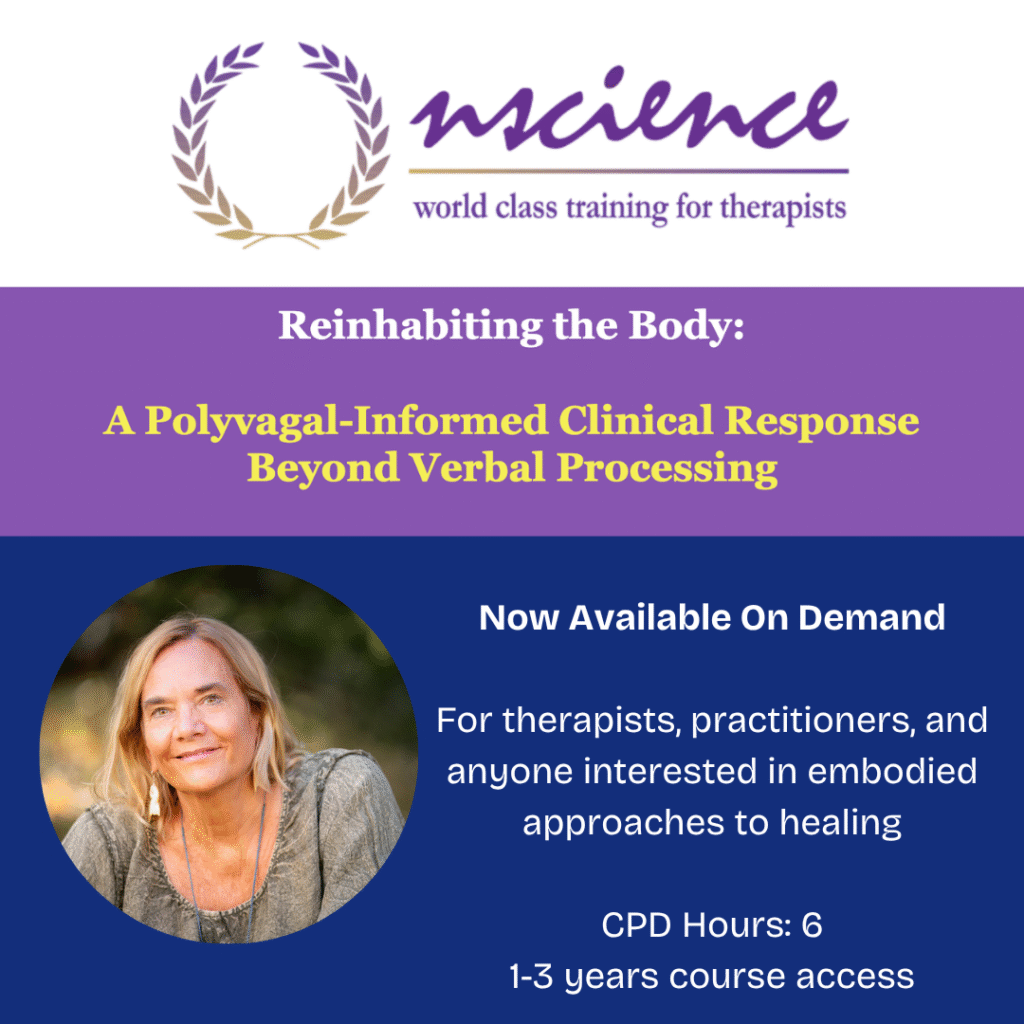
Blog: In The Presence Of Love

Whales are everywhere, here: they literally punctuate the ocean with their movements. In the space of a few minutes, looking out over the horizon or around the sea our boat is gliding through, we see pairs and trios and pods of whales breaching, spy-hopping, tail slapping and diving. This is an annual pilgrimage site, for breeding and birthing. These prisms of gem-blue waters serve as a safe place for the whales to create new life and tend to their young before they begin their own journeys back to Antartica.

This is big ocean. Tonga is in the middle of the South Pacific, and there is a lot of water. I am one of those unfortunate people who saw Jaws when it first came out, and am terrified of the deep. Having grown up near the ocean, and once been comfortable swimming long distances in it; I began to fear being out in the deep ocean, after seeing Jaws. Swimming with whales in Tonga—which I really wanted to do—meant I sometimes had to swim in deep ocean.

The trip I joined was also a freediving trip and I made it clear to the instructor that I wasn’t interested in freedivng—only whales. I think I was a little scared. But I had never really thought about it and it just seemed unnecessary: Why would I hold my breath and plunge into that deep? I just wanted to see the whales.

This blog isn’t about the apparent madness of the world right now, but it bears stating that the world seems particularly poised on the edge of many disasters, tragedies, horrors. My Utne reader just arrived with this on the cover: Curtain Call. Its about the end of us. I have believed that my niece and nephews generation may be the ones who see our species die out, for a long time. Its not a popular idea, but as the ice melts, weather destabilizes, refugees die in boats and get turned away from safe shores, fires burn, hunters kill precious beloved lions. ..The list goes on. This is why I went to visit the whales. Before I met them, I hoped they might inherit the world, because I have long believed they are far smarter, and more importantly—more compassionate than we. I think I am right.

Back to the water: In the midst of a crumbling world, my Father’s transition, my own free-float out of structured job and the assurance of steady contract work (i.e I am remaking my professional life), I needed to be in the deep. I visited Tonga in the coldest winter anyone could remember there. What that means is winds of 20-25 knots, rough oceans, cold water. The whales love the cold. I don’t own a wetsuit and have never free-dived and was not prepared for how physically difficult it would be to stay warm and float in this season of unusual weather. But that’s where the whales were.

Its kind of crazy to jump in the water and swim with whales. Whales are big. HUGE . Massive. And yet being in the water with them runs the continuum of deep rest to playful encounter. Whales see us. If they are not interested, they swim away immediately. If they hang out on the surface for a while, they may be beckoning you to join them in their watery home. If you swim to within 30, give or take, meters of them, they may remain floating on the surface or below you. They may get really still. They may then swim away. Or they may circle and arc a pathway that intersects with your tiny treading place in the giant ocean, and see you.

Whale babies seem delightfully innocent and clumsy; there are things they don’t know yet. They squeak like little puppies and often veer right towards you, unsure of their fins and tails; this could seem threatening because these “small” whales are 2-3 tons, but they are curious and want to try you out as a playmate. Mothers, and the male escorts (who may or may not be family) float below, intervening only if they are concerned for the baby, or the baby and her mom. Once one of our group members dove to soon and the mama turned and sped her baby quickly away. Another time the escort began to move because our group had inadvertently separated mom from baby. Some encounters are acknowledgements, and even feel like reacquainting with an old friend. On one of my swims, the baby rose up to the surface and then arced around and swam towards me, then crossed right in front of me. His eyes seemed to suggest that he or she was teasing me. He and his Mama stuck around, but not too close. To be above the silhouette of dark and white (each whale has its own very unique markings), and watch the long body glide effortlessly and slowly away, with a final view of the white fluke as it drops down deep, is magic.

One time a baby rose up to the surface about 10 feet from me, and I popped up to see it there, then when I dunked under, the mama was circling around and swam right by me, looking me in the eye. Are you a worthy playmate for my child? I guess I was. They remained and floated, swam, and even the baby frolicked for over an hour. The escort, whose was just a dark shadow resting on the ocean floor, stayed right under us until they began to migrate. When he rose up, a fellow swimmer was right on top of him and his extended leg was a mere 2 feet from his massive back. Its exciting, its calming, its soothing, and its deeply moving..

Free diving is an exquisite sport, and despite my initial lack if interest and fear, I managed to get to 8 meters on my second try. And held my breath for twenty seconds. It felt completely natural to be in ocean, and as a long time Continuum teacher, I realize that of course—this is home. We are ocean . 70% water. We need to breathe, but we can learn to hold breath to return to our origins and play beneath the surface. As my comfort increased, I began to dive closer to the whales beneath the surface I held my breath for longer times. And when a snorkel filled or a mask flooded and I fell behind my group and was suddenly far from the boat and far from the group in that deep stormy ocean, I soldiered on. Three guiding thoughts: You chose to be here. You know how to swim. If you see a shark just kick it.”

Somehow, I confronted fear and feel in love with free diving and with endless hours in ocean. It was ok to be almost landless for 8 full days. I left these encounters with the sense that the whales are in charge. They know we are here; they’ve been watching us for millennia. They watched life emerge from ocean to land, as they did; then when they chose to return to the ocean, they had seen creatures move on earth. They first heard our legs in the water and then perhaps heard canoes and kayaks, sailboats, motorboats, water ski’s. They hear the sonar of large naval ships (which often damage their usual migratory and feeding patterns) so they know we are here. They are always watching. So I think those of us who arrive out of curiosity and respect, with a sincere interest in learning about and from the whales, might be welcomed. I wouldn’t want too many people in the ocean at any one time, and for now, whale swimming is a privilege. It costs a lot to fly to Tonga and stay here for a week and access a boat that can take you out each day. It’s a once on a lifetime experience for many of us, and one that merits not just the action of being in the water with these ancient ocean wisdom keepers, but also reflection.

Read about whales. Read about the whale wars and whaling industry and the sacrifices they have made as they continue to forge on and steward the oceans. Watch movies like The Whale, and Blackfish. Whales are sensitive, intelligent, compassionate, and holy. When I contemplate the state of the world, I truly hope that if our human species dies out, whales remain and perhaps return to their rule.
To watch a baby whale nuzzle against its mother is to see pure love. As their long bodies wiggle like a fish, the mama stays soft and calm, allowing her child to playfully scratch and soothe itself on her rugged skin. They show wisdom, affection, and acceptance. They allow us to be in their space.

On my last day, I hovered above a mama whale, about 10 feet. She was resting in between ocean floor and ocean surface. Her fins were slowly undulating to keep her afloat. I gazed at the eyes on each side of her head, the top of her head where her massive brain is. We knew the other was there. I told her several times that I loved her. I sounded as close as I can to a whale song and while I have no idea if my tiny sound carried to her, if she heard anything, I trust she knew I tried to outreach my voice to hers. Whales truly feel like the embodiment of love. At home in the oceans, their powerful bodies swimming unbearably long and cold journeys, they move slowly, gracefully, fluidly in their watery realms. Its like being in a waking dream and witnessing the creation of a world. Dreaming. I am beginning to believe that whales not only welcome us; they long for us to respectfully be with them, in their environment, so that they might teach us how to be in this world. They displace a lot of water just in the act of breathing, and the massive ocean they dance in is still all around. Ever changing, their gift is traversing the unknown to ensure that life goes on.
And to remind us: love is big.

Australia & Continuum, Earth, Sky & Body: Spring 2015

There are still places in this world where the sky is awash with stars. Tasmania is one of them. In this Australian island, just off this most ancient land, the night sky is aglow with the light that emanates from the space that still illuminates the death of these once bright cosmic bodies.

To lie on the ground and look into the stars is to look into the mirror. There are numerous citations re: the relationship between humans, and stars. It’s carbon, apparently, that connect us; I am not a scientist but I have read numerous references to the relationship between us, and the stars. In essence, that we are stardust.

After guiding a Continuum Movement Depths Retreat, “At the Crossroads: The Serpents Dream”, outside Sydney; my husband and I traveled to Tasmania to visit a dear friend and to spend a week in the many places alive with raw and wild beauty that define this magical place.

Sydney, the most populated city in Australia, has far less people than New York City alone (#). I am not even sure all of Australia has as many people as New York City. I could look up facts about this, but I actually don’t care in this moment. What I am inspired to write about is how much we have lost, in human evolution and the subsequent development of “civilization”, of our connection to nature.

In Continuum, a movement practice and a life practice, we use sound and movement to engage with our own fluid body and nature. That we are 70% water, and the earth is 70% water, cannot be a mistake. It might be another mirror. The galaxies are also water blessed, and its possible that the movement, flow, and conductivity of water is an aspect of our planetary interconnectivity and holds potential for communication, restoration and healing. As humans, we often say “ we need each other.” Continuum Movement is a practice of breathing, moving and living this question of inter-connectivity and relatedness-between-everything, from the sea to the stars, and embodying the possibility of a sea full of stars.

In Continuum, we expand the concepts of interoception, exteroception, and proprioception: Bioception (our evolutionary, and current , connection to all things as expressed through the biomorphic movements that we engage with and become when we engage our fluid system); ecoception (our ability to connect to the natural world through our ability to express movement and communicate as wave motion, to be nourished and nourish our world and be reminded that we are not alone); Cosmoception (our lineage in the stars and galaxies; historical and future; the ultimate mirror).

Continuum Movement may be an antidote to the onslaught of technology, radiation, speed and crowding of our “modern” world. Continuum is where we interoceptively see the sky full of stars, no matter where we are, because we are seeing our own reflection everywhere.

2014 Trauma Resources International Annual Report

Today marks the five-year anniversary of the Haiti earthquake. I am acknowledging it today with my fellow Continuum Movement teachers. This is our first meeting since our founder and the creator of Continuum, Emilie Conrad, died. And this is the first time I have not been in Haiti for the anniversary of the earthquake.

Emilie Conrad was, and is, one of the most recognized and celebrated pioneers of somatics and movement arts. After a devastating childhood of alienation, illness and abuse, she found dance, and dance became her refuge and her sanctuary. In 1955, after years of dancing with Katherine Dunham, she moved to Haiti. It was there, in this land that is both enchanted and shadow, enlightened and troubled, she began to innovate an exploration into movement as healing, as artistry, and as life practice. This movement practice is called Continuum Movement.

Amber Gray, TRI’s Director, became an Authorized Continuum Movement teacher in 2006. Continuum Movement informs and inspires the framework for restoration she teaches in Haiti and elsewhere. When Emilie died on April 14, 2014, she left behind a devoted body of teachers who will carry her work forward.

Continuum Movement is a significant part of the Body as Voice/Restorative Movement Psychotherapy framework, and the IDEO team was introduced to it in 2013. They have requested more. When Emilie died she bequeathed TRI a significant gift that will most likely be used to create a training program, or perhaps a school, to bring somatic and arts based therapies to more of those who are requesting it. Since the completion of the training series this year (April 23-26, 2014, a one day wrap up of the Body as Voice series, and a two day training that focused on applying Restorative Movement Psychotherapy, with children affected by trauma) we have had requests from not only the IDEO team to continue the training, but also from educators, a program for autistic children, and community-based programs in the provinces, to begin the training series. We also wish to “fortify” the Training-of-Trainers component of the program through more depths training and on site supervision. None of this would be possible without Emilie’s generous commitment to Haiti.

We will work with IDEO to decide the best way to address the unmet needs of those affected by trauma, and to honor Emilie’s passion for, and deep devotion to, Haiti. Because Amber began the Body as Voice series in Lebanon in December, 2014, we will return to Haiti later in 2015, after the series in Lebanon is well underway and to allow for the IDEO team to practice and integrate their skills with ongoing skype supervision. We will continue to update this website with our plans and our progress.

Always, thank you for your support. Ayibobo,

Amber Gray, Director

Lebanon 2014

I am sitting in my hotel room in a lovely suburb of Beirut; for the past 24 hours I have heard sirens almost nonstop. Three bombings in 6 days; one in eastern Lebanon on Friday and then two, in Beirut, in 36 hours. A car bomb went off two blocks from the office I work in late Monday night/Tuesday morning and they arrested a dozen ISIS members in Hamra, one of my favorite neighborhoods in Beirut. It is breaking my heart to see Lebanon crippled under the weight of over a million Syrian refugees, bracing for floods of Iraqi refugees and waves of this insurgent violence that seems to be mushrooming here. It’s growing tense here. I will be leaving tonight with a heavy heart, a sense of personal relief, and deep concern for the violence that seems to be spreading so quickly in the Middle East.

Earlier today, as I joined colleagues to acknowledge the UN’s Day against torture (June 26th), and the powerful and courageous work of a colleague here, one of the explosions occurred in the next neighborhood over. I watched my Lebanese colleagues begin to frantically make and receive phone calls, checking on loved ones, being checked on themselves. The news is everywhere; these recent bombings retribution to Hezbollah for their involvement in Syria. Sunni vs Shia. My friends here say that the extremist groups “want to bring the message to Lebanon”.

A few evenings ago, I took a brief swim between work and dinner, and a lovely little girl (about 7) was playing, alone, in the pool. She smiled and approached me so I asked her name, and she willingly engaged. I learned that she was Syrian; that her Father was still in Damascus because he had work there and had to keep earning money; that her mother was “tired from all the fighting from the war” and was taking a nap in their room. She said she spent a lot of time, alone, in the pool.

When I was her age, I was never allowed to swim, unattended. There were hotel staff at the bar nearby, and one clearly was watching her, but she was playing alone in an adult pool.

This may be a cultural thing, and I have no judgment about it. But from my worldview, that a Mother is so tired she has to send her daughter to a pool is a simple reality of the consequences of war. It’s so easy to turn off the T.V., play golf, order a latte, walk the dog, go shopping. It can’t be easy to leave a little girl alone, in water well over her head, because the non-stop violence and brutality that you have been marinating in for years has exhausted you.

I attended a support group for adolescent age girls who are living outside Tripoli, in Northern Lebanon, about 50 kilometers from Homs, Syria. The facilitator is brilliant and very skilled, and because these girls and their families (if they still have one) are living in a seemingly eternal limbo, not yet resettled and not able to go home for the foreseeable future, this is not an in-depth processing therapy group. Its an activities and discussion/sharing-based support group, to offer the young women a little hope. One of the activities was to “draw a place that feels safe”. They did this in pairs, first sharing a little bit about this place with their partner. One pair shared a picture of a large hill. Underneath the hill was a shelter, furnished like a living room in a home. It looked inviting. Above the hill, rockets were falling from the sky and landing on the hill. When they shared the story of their drawing, one girl broke down, and said: “This is the only place I feel safe. I am not safe here in Lebanon because they do not want us. This is not my home. I am much safer in this shelter my father built, because it is my home.”

I have some precious friends here who I grow more concerned for; its awful to witness the escalating violence, and the pain and stress that of course increases daily for those living their lives here. These are lives just like yours or mine; lives lived by people who love other people, enjoy walks in the forest or along the beach, share their own form of prayer…..Yala.

Later, a moment to dwell. I walked through some of my favorite neighborhoods in Beirut. There are some old places here. I had a strange moment one night; sitting at the St Georges harbor, having dinner with friends, and some of the buildings were lit up in a purple hue. I suddenly felt myself at Sydney Harbor again—where I was barely two weeks ago! For a moment, I could not distinguish the geography of that moment—I not sure how else to express it. I was dwelling in the present tense of space, not place. The harbor was Beirut and Sydney and many other harbors, all at the same time.

Perhaps it was the purple lights; perhaps it’s the eternity of the ocean; perhaps its just pausing long enough to notice things that are the same, wherever we are.

The drive from Beirut to airport was strange. Usually, I am terrified of the drivers in Beirut; many cars seem to bullet down the highway, all going very fast. They cut one another off by a few inches without slowing down. Tonight, there are significantly fewer cars and I see my driver swerve many times to avoid any other vehicles we pass. I notice myself wondering if there is a car bomb in any of these vehicles. And when I catch myself thinking: “I wonder if the driver is also thinking about this; if that’s why he is voiding cars and sidewinding?” And then I think—what a strange thing to think about!

Twenty-four hours later, I am sitting on a bright white bench perfectly placed on a bright green lawn. I have been deposited by the airport shuttle driver at The Ethan Allen Inn, in Danbury, CT., a place I am familiar with from my childhood. Spent a few towns over. A bird sings cheerfully in the tree in front of me; it’s a warm, peaceful, sunny summer day in Connecticut. I remember them well—lazy, wandering days spent with friends at the local swimming hole or playing games in the many fields that were eventually replaced with surburbia. I am sitting at the convergence of so many realities—calm and peaceful; uncertain and frightened; my own childhood memories; old and new friends and colleagues I cherish in Lebanon. These worlds separated only by the surreality of air travel. It’s a strange place to dwell.


Australia 2014

I’m finishing a two-week trip to Australia. I taught two classes here, and after a year long run with quarterly trips to my favorite country on earth, I am somewhat numb to the reality that, trauma workshop series complete, I won’t be back for a year, give or take.

Australia is under my skin. Every time I leave, I feel sad if I don’t know when I am returning. This is the saddest I’ve been, because changes in my professional life mean it will be quite some time, and a little harder, to spend the extended time I am accustomed to being here, 3-4 times a year.

I am not going to write about the work this time, I am going to write about Australians. Every time I visit I meet a few remarkable people, and I am reminded why I wish I could just move here.

A good friend and I were walking in Tasmania’s bush; a delightful wetland of rainforest, waterfalls and pools. Towards the end of the hike, we noticed a man with sophisticated camera equipment, walking very slowly, taking pictures of patches of earth. We passed him a few times in our back-and-forth between the waterfalls, and we began to talk to him. It turned out my friend knew his daughter and they shared several close friends or family members in their circles of people.

He was taking photos of lichen and fungi, one of his favorite pastimes for many years. I estimated him to be somewhere in his 70’s. He told us about the different fungi we had seen that day and we talked about all the places over the past 40 or so years he had photographed fungi and lichen, in these very forests. As our conversation turned to travel, he shared that he had covered every inch of Tasmania’s forests and bush-land, many times, and constantly discovered new terrain through his unique and passionate lens on plant-life. He has been to the mainland a few times, but other than that; has never left Australia. As he shared his journeys through native walks that my friend, a local, had never even heard of, his descriptions brimming with love for this land; I realized that he had journeyed farther and to wilder places than I have after seeing more than 80 countries. The long distance nature and fast pace of my lifestyle does not cover the ground, nor does it offer the opportunity to love and caress place with such detail to name, beauty, locale.

He knows each and every subject he has documented as image in intimate detail. Before we began our conversation with him, we observed him spending 10-15 minutes contemplating a small patch of earth before he took a photo. A true journey.

Aussie bus drivers are the nicest in the world. One of the very first times I visited Sydney, I was trying to catch a bus to a beach area. I went to the wrong stop, and because it was a quiet part of the day, the bus driver (who was actually just finishing his shift) said “Aw, come on love, hop on I’ll take you there.” He drove me right to the beach, a few blocks off his route, and after his working hours.

Last night, I went to Vivid in Sydney, near the rocks, alone and by bus. The driver of my first bus ride, who took me into the city, didn’t charge me because he realized I was alone and not familiar with the area. He took the time to point me in the direction I was going. When I went to take the bus home, I waited at the wrong end of the station, and when the bus pulled up, the driver patiently told me how to get to the other side of the station, and to wait on a parallel street. When I started down the wrong passageway, he pulled a bus full of passenger’s over and called to me. I walked back so he could patiently, again, tell me exactly where to go to get my bus. He watched while I found the correct path.

This level of consideration is simple, straightforward, and remarkably usual in OZ.

Vivid was amazing. Australia may be way ahead of the US in combining creativity with technology. The opera house was alight with dramatic moving palettes of color, image, and music accompanying each digital dance. Each museum was transformed into a display choreographed by the latest technology. Very Modern Art. I danced on circles that lit up as different colors, depending on how hard you landed on them. It was an invitation to jump, skip, leap, and hop. Children and adults alike we laughing, and lighting up the enclosure by hop-skotching and dancing from colored disk to colored disk. I have always believed that all cities, towns and villages should contain playgrounds for adults. The negative energies, moods, consequences of our modern stresses and speed might be transformed into playfulness, love and community by what Dr. Stephen Porges research eloquently calls “mobilization without fear,” a state of energized movement and interaction with others. Mainstreaming adult play could be an anecdote to stress many of us frequently endure, and perhaps a preventative to violence.

Tennant Creek, Australia

Tennant Creek is a small town situated in a vast expanse of outback.  It literally sits at the edge of the dry, red earth climate of central Australia and the tropical top end of the Northern Territories. Just a few miles south of Tennant Creek (500 kilometers north of Alice Springs, the center; 1000 kilometers south of Darwin on the coast of the top end), the landscape is suddenly different. The termite hills are higher. The air is denser.  Its hotter. And its flat.

I was invited to teach a staff support day here by a friend of a friend, who was also organizing a similar workshop in Alice Springs. I chose to do this workshop over returning to New York City for the annual Dance Movement Therapy Conference at which I was to participate in several significant (and quite possibly “career enhancing”) opportunities.  I debated for a moment, but having been to Uluru twice, I am drawn to the outback…and could not imagine passing up an opportunity to travel to a remote frontier town in the middle of Australia. A few of my Aussie friends made fun at m excitement to see Tennant Creek—it is truly not near anything. I love space and I love going to uncommon places.

The workshop was attendee by government workers, local organizations, Indigenous people and white Australians. I facilitate staff care trainings as a process, vs. handing out the usual lists of to do and not to do. Culture, tradition, belief all become core to this process. When a group is mixed, at both groups were, and especially in a place like Tennant Creek where the original Aboriginal people are still connected to  country here, and who more recently lost it to colonialism and mining, dynamics are potent. There was a clear divide here, and yet all the people in my workshop were working with the indigenous people. One of them was a member of the stolen generation. That legacy is still an overwhelmingly present one.

I fell in love with Tennant Creek. Somewhat like Darwin but in a far less urban way (Darwin has a city downtown), Tennant Creek is a frontier town at the end of (or the middle of) the world. People living and working there have to be committed to the land. Its tough and honest. I slept really deeply to winds that had an echo I’d never heard before—perhaps because they had danced across such a vast open space, city-less and inhabited by a few cattle stations, indigenous communities, and the few Aboriginal people who can still walk their Songlines.

I had a few interesting events in the red center heart of Australia. One participant in two of my workshops came for a meeting to talk about some of the work we did, and as she walked into my room, she flatly said “I have a joey in the bag can I hang it somewhere?” Sort of like “Where can I tie my horse,” I was stunned at first, repeated her words and then wide eyed I’m sure, I said, “YOU HAVE A BABY KANGAROO?!”

Sure enough. She is a wildlife career and was tending to a very young kangaroo whose mom had been killed. I played with her, cuddled her and kissed her little nose and she accepted it without flinching. Australia has a wonderful tradition of wildlife caring; its tragic there are so many animals killed on increasingly busy roads, and, the tiny ones who are rescued from the marsupial pouches are well tended to. Appreciation for the joy of wildlife and the natural world is palpable here.

I spent much of my free day in Alice Springs at the Botanical Gardens, which are stunning. Descriptions won’t do the landscape justice. I’ve heard people “snuff” at the mention of visiting Alice Springs, because there is “nothing there”. I actually appreciate places of nothingness, because there is stillness, and quiet. However, as with most “nothing” places, one only need pause long enough to settle eyes, ears, and all the senses into then landscape (or seascape) and there is a discovery garden right here.

Alice is a place of spaciousness, extraordinary red earth that truly does pulse with a heartbeat from the center of this ancient continent. Amazing, colorful, adorable  wildlife; a chorus of bird songs that permeate the air  with melodies unique to this land and sky; legendary rock mountains whose stories go back 40,000 or more years.  The obvious and ongoing pressures of the colonization of Australia by Europeans are still evident here. The connection between the Indigenous peoples of Australia, and this land, is also palpable; the abject poverty and forced disassociation of many Aborigines from the earth source  of their stories and traditions is painfully clear. This is country for many of Australia’s indigenous, and there is clear disparity between them, and the white settler descendants. Being in Alice is like standing in the heart center and feeling its brokenness all at once.

2013 Trauma Resources International Annual Report

On January 12, 2013, I was in Haiti for our Trauma Resources International (TRI) Ke Ansam program. This year, we marked the 3-year anniversary of the devastating 2010 earthquake. There were several commemorations, though not to the scale of the past 2 years. This year, most Haitians spent the day with family, in quiet and deeply personal reflection and acknowledgement. I spent the day with one of “my” families there; Dr. Roseline Benjamin and her children. The night before, we listened to her son Mikaben perform at a new restaurant/ performance space in Port au Prince. His song “Ayiti Se” has become very popular, and I first heard it in the second session of the current training series we are providing for psychologists and social workers. It’s a stunning song, that acknowledges the beautiful, historical, spiritual and magical aspects of Haiti in a way that celebrates her, rather than mourn her, as much of the current news coming out of Haiti still does.

MIkaben is working on a documentary, inspired by “Ayiti Se”, which will share everything that is beautiful in Haiti’s extraordinary history. This film will document the many places, practices, traditions and “Haiti’isms” that weave the historical and spiritual fabric that form Haiti’s unique resilience and beauty. TRI has already supported this film project by creating an opportunity for Mikaben and his crew to attend the sacred ceremonies to honor Ogou, the Lwa (spirit) of Warriorship, and Truth, in Cap Haitien and Limonade. We also visited the scared mud baths in Plen du Nord that occur annually for Ogou. These visits took place July 24-26, 2013, just a few days after we completed part 5 of “Body as Voice”; July 19-21. (Photos are posted in the photos section). This training was a transition training: we are shifting more explicitly into the training-of-trainers format, so that the IDEO clinicians who have been attending the training series can begin to share and train other colleagues wishing to integrate Restorative Movement Psychotherapy into their practice.

The generous contributions, donations and funds awarded at the end of 2012 by The Frost Foundation, The Kind World Foundation, The Marian Chace Foundation, Charles F Gray Trust and Donnalea Goetz will support the ongoing Body as Voice: Restorative Movement Psychotherapy for Survivors of Trauma training through to its completion in 2014. Part 6 of the series was scheduled for December 2013, but had to be postponed due to the ice storms that paralyzed DWI (and cancelled all the flights TRI Director Amber Gray was scheduled to take to Port au Prince, 3 days in a row). We are currently working on the reschedule. Following Part 6, we will take a brief break to allow for the integration of the material, and then TRI will provide 2-3 more trainings in specialty areas such as working with children; integrating ritual and spiritual practice; Continuum Movement and other to-be-determined topics. TRI only offers training in direct response to requests by the recipients; the amazing clinical team of IDEO wants time to integrate and practice what they have learned so that they can request future training topics that will focus on their immediate and long-term practice needs.

As always, thank you for your generous support. TRI welcomes your donations for its ongoing work in Haiti. As we move towards completion of the Body as Voice training series, we will continue to work with IDEO’s projects (which include Mikaben’s documentary project; Child Psychologist Melodie Benjamin’s budding non profit program for traumatized children; and IDEO’s summer camp for children who otherwise do not have opportunities to attend camp). Just as Mikaben sings in his ballad tribute to Haiti, TRI is committed to working locally with organizations and people who enhance and highlight the true spirit of Haiti. When we return to Haiti in 2014, we will meet with our IDEO colleagues to determine our ongoing collaborations.

Bon Anne Nouvelle!

Haiti: New Life

I don’t know how to begin this blog. I left my Haitian home this morning, feeling tired after 11 days of teaching stacked up onto ceremony and cultural gatherings. I felt tired and gleeful. The sun was shining (despite warnings four days ago about Tropical Storm Dorian) and Haiti, for the first time in a long time, was sparkling like a jewel. So I thought about beginning like this: Ayiti Cherie, you are sparkling again, resurrecting your former place as the “Pearl of the Antilles”.

By the time I was boarded on my plane and sitting at my computer, however, another beginning had emerged: The unexpected is to be expected. Actually, there is no unexpected in Haiti—expect anything and everything. I was upgraded to business class, and looked forward to a relaxing journey (3 flights!) home. As soon as I settled my luggage into the bin, I sat down. I suddenly felt that my seat was damp. I stood up, and sure enough, the seat was wet. So were my pants, all the way through to my underwear.

After reporting it to the crew, I went to the bathroom, and am sad to report that it smelled like urine. I reported this to the crews, and they were not surprised—a very elderly woman sat there just before me. I have seen several people pee in the middle of the aisles on fights to and from Haiti, being unaccustomed to the more formal structure of flying bathrooms, so I wasn’t surprised. But I felt gross. The airline changed my seat; all they had was an economy class seat which was much harder and smaller—that was an interesting revelation. I always knew the front cabin was more comfortable—now I know why. It’s a seriously different seat.

I did my best to clean up and dry off. Half way through the flight, I went back to the bathroom. When I returned to my seat, lunch was served. As I sat down, I once again, felt wet—on my hands, arms and sleeves. Red wine!! Everywhere! The man sitting next to me had spilled his red wine everywhere, and not said a word. He WATCHED ME sit in it, and put my hands in it. All I could do was thank him, loudly, for masking the urine smell with the odor of red wine, and get some soda water to dab out the stain.

Obviously, this could have been a very irritating situation, but I had to laugh. Wine and piss. This is very Haitian (though rum and piss might be more apropos). One becomes the other. The cycle of intake and output, nourish and eliminate, life and death. I left Haiti with the distinct impression she is in the midst of a grand resurrection, a phoenix rising from the rubble, and while things are far from perfect, there is much to hope for in this country that is too often defined by its misery and corruption indices.

The gems: the parks that were not too long ago tent cities are now brightly painted, refreshingly colorful, play-provoking sites. It’s common to see children playing on playground equipment, lovers or friends holding hands as they stroll through the parks; families enjoying being outdoors together. There are many more freshly built and paved roads, connecting not just places in Port au Prince to one another, but also other cities (Hinche, Cap Haitien) to Port au Prince, which suggest the possibility of decentralizing services and development throughout the country. Even the recently finished brand new road from Port au Prince to Cap Haitien, which was partially destroyed by Hurricane Sandy last Fall, was being rebuilt, again. This never used to happen in Haiti!

I also saw many, many billboards (the primary way to advertise performances and social events) lining the major driving routes in Port au Prince, displaying everything from galas to sales to music to theater to dance to anti-trafficking campaigns and human rights messages. The color, enthusiastic messaging and sheer number of these billboards are encouraging: they show that there are a lot of day and night-time activities going on in a city that just three years ago was shut down by a devastating, murderous earthquake, and that 6, 7 and 8 years ago was shut down by violence. When I lived there in 2004-5, we often had 6 pm curfews.

There is a fair amount of criticism, and equally, uplifted spirits, being expressed by people in Haiti, for their current President. That he had no true political “upbringing “or experience prior to his election can certainly be a point of contention; he has made some mistakes. However, what almost every Haitian friend, colleague, or acquaintance I have talked to about Martelly says about him:

HE LOVES HAITI. HE LOVES OUR COUNTRY.

And, he is teaching Haitians (especially children) to reconnect to Haiti’s long and rich history of culture, spirit, arts, and independence with pride. Students can now do school projects in Kreyol (they have a choice). There are more folkloric dance troops, and more performance spaces and nightclubs to watch them in. There is more traditional (across generations and genres) music to listen, dance and celebrate to. There are two “Kanavals” a year; not just one, as there used to be in the mid and late 1900’s ,before the awful embargo years. Much of what I see emerging under his presidency is the color and magic of Haiti’s soul.

I have written about this before: The more deeply acquainted with, and connected to, Haitians can become with their own rich artistic expression and culture (which so much of the world, unbeknownst to many Haitians, celebrates while they have learned about their own practices and artistry as shameful, primitive or sorcerous), the more Haiti can restore the strength, vibrancy and integrity that is inherent in her individual and collective history.

Japan: Bamboo, Butoh & Bums

A newly made friend, who took my Radical Freedom Continuum Movement class in Tokyo in June, just arrived for a visit. Her welcome presence reminds me that I never finished my Japan blog; so here is an updated version, based on her sharing, this morning, of a lovely healing experience initiated by Santa Fe’s magical light. This is the same light that calls so many artists to this land. Before I moved here, I often visited here for replenishment and sanctuary. So without sharing details of her private journey, I will share that it is a lovely reminder of how restorative the land in New Mexico is.

I will share that her description of the light and movement of tree branches reminded me of the first time I traveled to Japan, in 1981, to study Haiku. Haiku has always been my favorite poetry form. I was in college at the time, and without knowing anyone other than a High School friend’s family (whom I stayed with), I ventured there to learn as much as I could about this seemingly simple, yet deeply complex, poetry form. I went to libraries all over the city and read as much poetry, and description and analysis, as I could. I sought out poets to learn from them. And, I wrote. Of all the poems I wrote, only one received praise from my then poetry teacher, who simply said “Yes. You got it. This is Haiku”.

The poem, which is about the moon, is long gone. It did get published in our college poetry journal, which I hope to find someday.

Other than this aspect of my experience, I was not crazy about Japan. It was super busy and crowded. People yelled at me, for Hiroshima and Nagasaki, on the subway. One man poked my breasts on the subway, mumbling something about American women. And when I saw a woman being beaten at a railway station, by a man, and I began to intervene; I was held back and told: “You can’t interfere. This is customary here; it’s ok for a man to discipline his wife”.

When I was invited to teach in Japan, I hesitantly agreed, mostly to cover for a colleague who couldn’t make the trip. I was more than pleasantly re-introduced to some of the magic of Japan, and now find myself longing to return. Having seen several Butoh performances, I experienced a visceral connection to the powerful, dark, and contemplative nature of this particular Japanese art. And having spent much of the past 30+ years since I was in Japan working in multiple contexts of violence across vast cultural spaces, I am better able to enter another cultural context with less judgment and more witness presence.

What I actually wish to share about Japan is my great amusement at their toilets. Yes, there was plenty of magic and sanctity: bamboo (my favorite plant and one that I believe can offer healing on so many levels), Butoh dance, ancient ocean water hot springs, Buddhist temples. But one of the things that truly amazed me is their innovation, as exemplified by their toilets.

When I was in Japan in 1981, all the toilets I used were squat toilets (which I actually like because they are better for the low back). On this trip, I encountered not only a modern standing flush toilet, but a modern standing flush toilet with features.

Some of the features are:
Flushing sound
Bidet
Butt-washing (it had a nicer name, but I can’t remember it)
Drying

The first time I used one of these toilets, I pushed the “flushing sounds” button. The toilet made a flushing sound while it wasn’t flushing! I asked my class the purpose of this, and they giggled, and then stated that it was for making a flushing sound when you were too shy for others to hear your peeing. I then realized how extraordinary it is to be able to disguise any human elimination sounds that might emanate from a public bathroom stall. Brilliant.

I didn’t try any of the other buttons until my last day, because I was a little scared of them. By then, I figured I needed to at least try before I left the country.

I tried the bidet first, and fortunately, it turned itself off after a few moments. Then I tried the butt washing button, and it freaked me out. Not knowing how to make it stop, I stood up, and—the water began spraying all over the stall, and beyond it! I heard people yelp from the other side of the door and there was a bit of chaos and yelling. Apologizing, I sat back down and bore it until it stopped (which seemed like several minutes). Once the toilet calmed down, and I calmed down, I found the “off” button. I stayed in the stall until everyone else left the bathroom.

I didn’t tell anyone about the incident, and no-one in my class said anything, so perhaps none of them were there. What was interesting for me, because of my interest in the parallels between fractal geometry and intergenerational trauma, is that later that evening, when we visited the ancient ocean hot springs, I was bathing in the communal bath rooms, where you sit on a chair in your own stall without walls, and bathe yourself with a small hand held shower. I don’t really know what happened, but within a few minutes of beginning my bath, my hand held shower seemed to develop a mind of its own, and I suddenly heard a scream from a woman to my left. My hand held shower was spraying her!!!!! She was calmly using a bucket to rinse herself, and was suddenly doused by my shower water.

I am not suggesting that this was an example of intergenerational (or any) trauma; when I apologized in Japanese several times, she kindly laughed and resumed her bathing. I bemusedly pondered at the likelihood of my spraying people in Japan, twice in one day, with water gone wonky. This is where the inquiry into fractal geometry (i.e. a self replicating equation being a metaphor for how the Fx*$ did that happen twice in one day?!) comes into place. I was there to teach Continuum Movement which is the most fluid, watery movement practice I know. Continuum is an ongoing inquiry into water as connection, healing, and life. This is certainly something for me to contemplate: Having shown up to share a movement practice created from the restorative aspects of water, I actually caused some surprise—and even some startle—by spraying complete strangers with bath and toilet water.

A Visit To Foundation House

Amber’s visit to Foundation house, one of the global leaders in torture treatment and refugee well-being:

View PDF Article

Amber elected to The American Dance Therapy Association (ADTA) Board of Directors.

Beginning in October, 2013, Amber will become the ADTA’s Western Region Member-at-Large, for a two year term.

http://www.adta.org/

Lebanon

This is my second time to Lebanon. It’s always difficult to put into words why one loves certain places with a particular fierceness. Lebanon is one of those places for me. When I left here, 3 years ago, I felt really sad that I might never come back. Despite everyone-who-cares-for-me concerns such as “Is it safe?” Why are you going to Beirut”? Isn’t Lebanon awfully close to Syria”? I couldn’t wait to get on the Middle East Air Liban flight from Paris to Beirut.

I travel a lot, and never feel like I am too far from home. I’m good at traveling—don’t get jet lag, sleep right away on my new schedule, feel pretty energized within 24 hours. I have some very good friends here, and we were visiting the magnificent Cedar forests of northern Lebanon yesterday, and talking about my feeling of connection to this truly ancient place. I don’t know if you’ve ever remembered something long-tucked away in a memory crevasse, but I suddenly realized that one of the first foreign people (if not THE first) I have ever met (or have a recollection of meeting) was a Lebanese man, Sharif. Sharif was a groomsman in my best friend, Susan MacDonald’s, older brothers wedding. This wedding was a big, big deal for me—-and representative of the kinds of kindnesses best friends parents show to the little ones who are important in their kids’ lives. I had never been to a wedding and coming from a small family with most extended family members living far away, would not have a chance to go to many weddings (I have been to less than 10 or 15 in my life) so the dressing up, the fanciments, the ritual and sanctity were all a first for me. So was meeting Sharif, who aside from being one of the handsomest men I have ever seen (yes, to this day) was one of the kindest. On my second trip to Lebanon, I am finding that these are not such unusual attributes here.

Susan and I stared at Sharif a lot, and giggled and probably pointed. His response was to spend time speaking with us, and he told me about Lebanon. His words created an image – a very visceral one—of a land of mountains and sea, of glittering and lively cities and ancient places; I think in my little girl imagination (I was still in grade school) it probably sounded like paradise. So I have always wanted to come to Lebanon, and sitting here now, with dear friend and colleague Dr Rabih El Chamay (who is ultimately responsible for the invitation that brought me here in late 2009), I am really touched to remember the kindness of a once stranger so many years ago that planted the seed to visit not only Lebanon, but also the world. Many years and wars later, I hope Sharif is ok.

Lebanon has many treasures, and on this trip I have been to the north and the south, and must comment on the variety of symbology one encounters while driving Lebanese highways. Headed South, within 30 minutes of Beirut proper, there are Lebanese flags and Hezbollah flags lining the highway; billboards of martyrs appear every so often all the way to Tyr. Headed North, one is soon winding though mountain villages and seeing images of Mother Mary and innumerable saints, everywhere. The canyons and hillsides are dotted with ancient…I mean truly ANCIENT—monasteries. It’s like being inside a quaint, old-fashioned Christian history lesson.

A primary reason for my travel here was to present a dance movement therapy workshop at the NISCVT annual conference. NICSVT is an organization that works with the many Palestinians refugees who have been warehoused here (yes, that’s really the term) since the 1940’s. The focus of this years conference was on education for refugee children—as I am sure you, the reader, can imagine, there are many issues with education for people who have been living in a stateless condition in a country that will not grant them full status to study, work, or participate in daily society. The relationship between the Palestinians and their Lebanese hosts is a long and complex one, and I won’t elaborate here. I learned a lot on this trip; about Palestinian involvement in (and instigation of) some of the horrible conflicts that have plagued Lebanon since the 1970’s. Having visited at least 4 camps in Beirut and Tyr, I have seen the conditions that the Palestinians are forced to live in; in self constructed mini cities with dangerous wires dangling thickly over every alleyway and blocking the sky. Buildings and alleys through these mini cities are cramped, crowded and dirty just from the sheer impossibility of squeezing anything else in. People are literally living on top of one another in a city planners unplanned haphazard nightmare.

I was part of a panel of co-presenters who spoke of dance, music and arts therapies. We were asked to summarize creativity in the learning process, and one statement really stuck out to me: a rationale for limiting the numbers of children in school (many children here do not have any access to school) because there are not enough seats. Both Deborah (the music therapist) and I spoke to the issue of learning as a process of creativity and development…and my comment was simple: Kids don’t need seats. They need space. And it doesn’t have to be a lot of space. Those of us who enjoyed liberal childhoods exploring safe landscapes are blessed to have known space. The space I am referring to is the space to have a place, to exist, to belong. Giving each child a place is more important than a seat. Children learn (the younger, more so) through exploration in sensation, movement and creative expression. A balance in structure and freedom is essential to healthy development. Refugee children, by definition, do not have this balance. These refugee communities who have been defined by their refugee status for as many years as the Palestinians have, deserve the right to, space for, place in, education. If there are no literal seats, the children can sit on a mat, stand up, move and play as they do in many experiential educational settings. Of course, this requires resources, and resources are scarce for the Palestinians, and also for the local Lebanese NGO’s who support them. There are many remarkable, highly educated, very intuitive, courageous people working with the Palestinians in Lebanon.

In addition to the many Palestinian communities, there are estimated to be a million Syrian refugees in Lebanon. Most of them live with host families or, if they have the resources, are renting homes. Many are living in the Palestinian camps. Lebanon is a tiny country; in March I wrote about the impact of increasing umbers of Syrian refugees into Jordan, which is buckling under the pressure. The same can be said for Lebanon. UNHCR is trying to meet the many needs (complex health care needs, mental health needs, basic needs), but the needs outweigh the abilities or resources of any single agency or country. Bluntly, its time for the West to ease the burden of the humanitarian crisis that is growing on a daily basis in the Middle East. I recently read that many Syrians are being denied asylum status in the European Union; there doesn’t appear to be any movement to resettle the Syrians yet. I do know there are practical considerations in any countries resettlement numbers and demographics, and, I also think there is a lot of politics and fear that determines who gets refugee status, where, and when.

Many of the Syrians prefer to go home, and are waiting to go home. But until there is a sincere and concerted effort by the global community to intervene (which I do not condone on a consistent basis) in this clearly long-term and horrific conflict, there is no home for the Syrian people to return to.

Daryl Byler, Regional Representative of The Mennonite Central Committee in Jordan visits Zataari Refugee Camp

Following their visit to the Zataari Refugee Camp, Colleague Daryl Byler, Regional Representative of The Mennonite Central Committee in Jordan, writes about the camp and its impact on Jordan, in Religion and Ethics. Click here to link to article.

Syria/Jordan

It’s the first time in 4 days I’ve had a moment to step outside. I am in Amman, and spending some time in the camps on the Syrian border, to assist in the development of a staff care program for the many humanitarian responders working with the refugees fleeing Syria.

Having been indoors for several days, I am instantly inspired by the warm sun, bird songs, and call to prayer that begins to resound from some not to distant speaker. I have always loved to hear the call to prayer. I don’t understand it, but I hear the spirit. As I walk through a mostly residential area of Amman, I am struck by how peaceful and calm it feels. We are not even an hour’s drive from the border Jordan shares with Syria.

I have been to Jordan once before, as a tourist, and it can be a deceptively simple place. There is not as much obvious diversity in landscape as other places; it is a fairly new place so the architecture isn’t always as interesting as it is in some of the surrounding, older places like Damascus and Jerusalem. It can appear bland. There are some interesting nuances in the landscape, though, if one really observes well.

For instance, watching Lawrence of Arabia on the plane flight home, I saw the scene where he is almost dancing as he explores the freedom of movement his new outfit (he has been gifted with a traditional white robe) affords him. He is swooshing across a sandy landscape that is interrupted only by craggy rock mountains. If you look closely, the mostly red sand that covers the higher elevations literally stops at borders where the sand is suddenly pale beige or tawny brown. It’s a dramatic color dance within a deceptively monotone swatch of earth.

I knew instantly that this landscape is Wadi Ram, because when I was there, I was delighted to be able to collect 3 distinct colors of sand within a few feet.  There are not many other places like that!

Dealing with the Syrian refugee crisis, I learned much more about the true nature of Jordan.

Bedouin hospitality culture is at the root of Jordan welcoming so many refugees. In this ancient tradition, a guest arriving to your desert dwelling is offered three days of rest, food and shelter.  There are approximately 2,000 refugees arriving nightly, to the Zataari camp I visited, from Syria.

Jordan is reeling from the impact of this crisis. It’s estimated that over a million refugees will flee Syria by the end of this year, if the conflict continues. They are going to Iraq, Turkey, Jordan and Lebanon. The Zataari camp on the Jordan/Syria border only opened in July and has over 120,000 refugees now. It’s busting at the seams. While there, we saw a map of the camp and in just 6 weeks, it has increased by over 200% in size.

When we visited the camp, we spent time with families who have been in the camp since autumn. The grandmother, 88 years old, had to be carried by her son from their home in Daraa, where the revolution began. Because she has knee problems, she has a difficult time using a toilet, and needs help. In the camp, only latrines are available, and the rapid explosion of arrivals (on one night while I was there, almost 4,000 new refugees arrived) means there are not enough, and not clean enough, hygienic facilities for the refugees. Imagine having to carry an elder in your family to a filthy latrine to go to the bathroom? Most of us would consider that an affront to our dignity. It is an affront to our dignity, and this would not be tolerated in many of our communities.  Yet the world falters in its promises to send the aid committed, and a handful of countries—Jordan, Iraq, Lebanon, Turkey with some aid from The Saudis and other Gulf countries, support this growing community of people fleeing hell.

I cannot help but think of the response some Americans had to the increase in border crossers from Mexico, during one of the most dangerous periods of violence in border cities like Cuidad Juarez.  People were waking up to dismembered bodies and missing women, and the US responded  with Civilian militia patrols and a wall. This is not to question the need to manage our resources and protect our land and people; it is to suggest that the depth of hospitality and social responsibility demonstrated by a country as resource poor as Jordan might be a model for accepting the realities of a truly global community where suffering is widespread.  We are connected, and as I often say when I am teaching my movement therapies for trauma classes:  If you think you are here for yourself, you’re wrong. We are here for each other. That’s “rule” #1 in the post-trauma restorative process. No-one heals alone.

I am hoping to return to the Middle East several times this year to assist with this humanitarian tragedy. I encourage those of you who can to donate to organizations supporting the people of Jordan and Syria: Lutheran World Federation, The Mennonite Central Committee and UNICEF are all doing good work with very limited budgets.  You can earmark your donation for the Syrian Refugee Crisis. If you do, thank you.

When I visited with the 88 year old Grandmother, we did not have common spoken language. She gestured enough to tell me that some nights, when they were in a tent (they had just moved to a much sturdier 4 walled structure provided by Lutheran World Federation) she had to endure rain or even snow falling on her. It was cold. She is  a healthy woman who has never had knee problems before; now, walking is very difficult because of the pain in her joints, a consequence of those long cold nights and the hard journey to Jordan. She has never lived anywhere but Da’raa;  she wants to go home. I have worked with enough elderly refugees to know that the greatest heartbreak is to not be able to finish out ones life in ones community.  We of the once dominant white culture seem to hide our elders in nursing homes in the United States. In other more socio-centric cultures, they are honored, acknowledged, and listened to. They have a place.

If the predicted one million refugees from Syria really do arrive to the expanding refugee camps in surrounding countries by the end of this year, that’s a million more people than there were before this war began who have been uprooted and ripped from their place. March 15 is the two year anniversary of the start of this civil war. Some speculate it will drag on for years; some of the refugees in Zataari believe they will go home in a few weeks. They rely on news from family still there and there are reports that al-Assad is hiding in a mountain fortress, and will soon have to escape Syria if he wants to live. They hope this is true so they can return to their homes. It seems unlikely to me, but I would never utter a word that would undermine their hope.

I hope, Inshallah, that the world will match Jordans’ hospitality and commitment and find a way to support their care of the Syrian people, and that it will be sometime soon—very soon– that the 600,000 displaced Syrians can all return to their place.

Haiti & Australia

4:53 pm, 1/12/13. I am turning our car into Belvil, the quiet neighborhood, where I stay in Port au Prince. It is the precise moment when the earthquake of 2010 devastated Port au Prince 3 years ago. My friends, colleagues and I have spent most of the preceding week talking about how impossible it is that 3 years have past. As I observe the life on the streets, I see hundreds of people on cell phones, selling market wares, buying, walking and sitting while sad, thin dogs scrap for food. I muse at the thought that perhaps none of them are aware that 4:53 pm is upon us; 2 years ago, at the multiple 1 year commemorations, there were thousands of moments of silence around the country. Today, life is doing the usual, just as it was in the moment the earth opened up and shook, rolled and slammed.

I think it’s incredibly sane that life goes on. I spent most of the day being with close friends who I reached out to within minutes of my learning about the earthquake back in 2010. We talked about the elegance of how many people are in simple observation: a trip to the cemetery (or, cemeteries); visits to sites where friends and family perished; time for reflection with family. One friend shares how a dear friend of hers who lost her husband and was left alone with 3 small children, woke up, fed the children, took them to see their fathers grave, and then came home to do the very things they all loved to do together, reveling in the safety of their home. And their togetherness.

My friends son, a musician who wrote a compelling song about the beauty that is so paradoxical to Haiti’s many challenges, says “3 years already? The bruises still seem fresh”.

The song I am referring to, “Ayiti Se” (check out the official video on you tube; Ayiti Se Official Video Mikaben) celebrates everything Haiti is. There is no dwelling on what Haiti isn’t, hasn’t, or lost.

This is the spirit that showed up in the immediate aftermath of the earthquake (and so many of Haiti’s other tragedies and calamities) that so many of us labeled resiliency. It is resiliency, and; its more. One of the conversations about future projects I am engaged in, on behalf of TRI, is support for a documentary about these places, historic moments and cultural practices, that are Haiti’s ancient heart and soul. The richness of these places is available to all of us. I have other projects cooking, related to revamping Haiti’s education so that children, from a young age, are taught to appreciate their rich and diverse cultural and spiritual history (I blogged about this in 2010). While I acknowledge the importance of never forgetting this terrible tragedy, I tire of the media’s ongoing focus on what’s still going wrong. Yes, I am outraged that so much promised aid never made it, and that people are forced to live in and around rubble. It is a slander to human dignity.

And while I am deeply concerned at the erosive quality the ongoing challenges of living in poverty, rubble, and violence have on Haiti’s blood-and-spirit resiliency, I am in awe of that resiliency. Its worthy of a deep bow, and celebration. So, from now on, TRI and my personal efforts will focus on projects that bring to a world thirsty for compassion, goodness and joy; the upswings in Haiti’s current path.

This reminds me: Here is a blog I began over a month ago, and haven’t had time to finish. Its about my last visit to Australia, and changes happening there:

12/9/12
I have just learned that the ceremonies I have attended for the past 2 summers, with the Pitinjara, are ending. Just a week and some before 12/21/12, the last day of the Mayan Calendar (to which I have not subscribed much meaning or paid much attention). These ceremonies have been going on for over 20 years, maybe 30, as a movement to bring whites and blacks together, old (original) and new Australia, and to heal long festering wounds of racism and divisiveness and exclusivity. I don’t really think the worlds will end on 12/21/12, but I do think many indigenous teachings will emerge with some truths or revelations that the “modern” world needs to know. That’s the ceremonies are ending breaks my heart: Where will I go now? It became crystal clear to me last year, under that endless star studded sky, that ManShoun had connected me here, via my friend Annie and her Spiritual teacher, Nellie, who dreamed these ceremonies into being, so that I continued to have ceremony and women, mothers, teachers in my life. Now, contemplating the possibility that they might be all gone, I feel bereft.

But beyond me—this is so much bigger. Its a sad ending, but perhaps also signifies that those of us who shared this experience with the Aborigines have received the transmissions we are meant to receive, and we now know to (even if it’s a knowing that exists below cortical thought) what we must be prepared for in this new period we may enter after the 21st.

Again—I am not into any of the drama that has surrounded the 21st,
as I am even flying home that day. But I do think the ending of indigenous calendars, traditions and gatherings is significant. What we carry inside will matter more.

Here are some journal entries form my last time in ceremony, in Australia’s vast outback:

Sleep 5 nights in the outback and there is no doubt that Australia is the oldest land on our planet. Never mind the sharp cold at 4 am if you have to crawl out of your swag for a pee, or the intense heat and layers of dust you breathe in when its almost 100 degrees and the wind kicks up and there is no shelter. This place is heaven. Considered the heart center of Australia by many of her indigenous people, I believe the Uluru region may be the heart center for the world. And this is what, in some Aboriginal languages, the name of Australia actually is—mother land. Center , heart, navel of the world.

I have spent another 5 days in ceremony with the Pitinjara women. Once again, I can’t share the details or what we experience in ceremony. What I can share is the magic of sleeping under the thickets blanket of stars I have ever seen. On our second night, I woke up in the middle of a very dark, almost moonless night, and the Scorpio constellation (my sun sign, and I also have 4 other planets there) was perfectly aligned above the screen in my tent. I actually opened the panel to look up and make sure I wasn’t imaging this. I wasn’t. I lay back down, and looked up—-perfectly aligned, hovering in the only opening to the sky I had available to me on this coldest night, was Scorpio in the stars. That’s the kind of magic that can happen out here.

What I can also share are my thoughts and reflections about the meaning of this exchange, of 20 or so white Australians (and 2 Austrians and one American) being present for these ceremonies. It’s a reciprocal exchange. I didn’t grok that last year; I did this time. We do not do exactly the same things, for we are not allowed to do many of the things the Aboriginal woman have done for 10’s of 100’s of years. Our being present, our many acts of witness and the ongoing witness presence we provide, is a mutual reciprocal exchange. We are there to reflect back to the women the value, integrity, beauty and eternity of their traditions.

The Reciprocity is in the quality of attention we bring to this exchange, and the
mirroring is in the activities they teach us to do, with and for them.
Its not mirroring in the usual sense because it is not an exact replication. Like the concept of mirror in Vodoun, another ancient tradition, it’s the mirroring that takes place when the gathering of people who are alive — here and now — honors , acknowledges and calls up the ancestors who guided us here; and listens to the earth that always sustains us. I left feeling as if I had experienced a moment of what eternity is. It’s the continuity and ongoing tribute to the past, to our histories, her-stories, stories and ancestries, and the deep knowledge that we are just a flicker of a moment in a constant unwinding of life that will evolve in ways and depths we may not even dream (except for those who really know the dreamtime).

We are taught not in a didactic exchange but a purely energetic one, through listening and witnessing, and then reflect back for the women what we have learned.
As in many places where indigenous culture is threatened with eradication by the ongoing effects of Colonial dominance and oppression, its harder to find younger generations to carry these traditions. In no way are we, the whites who have gathered here, being taught to carry this brilliant tradition, but we are being taught to remember it. This is a mirroring of practices that still permeate all time, past, present and future. Geography and skin color do not matter.

I think I learned what matters here. It is: Listen to the earth and be danced by all the ancestors. They are the only ones who can guide us forward, in balance, love and dignity.

Haiti and The World at Large

I didn’t take the early flight from Miami to Port au Prince (“PaP”) today because I tend to not sleep when I have 5 am wake-up, and I had to teach the first day after my arrival. July is always a busy travel time between Miami and PaP as many Diaspora visit Haiti and many Haitians visit family in the US. It’s also the time of many important ceremonies d’ Vodou (Plen Du Nord, for Ogou/St. Jacques); Limonade and Lory all celebrate these as does Sodo.

I was a little irritable because of a pretty significant auto accident the week prior to my departure. I was rear ended on the interstate because the traffic came to a sudden stop. The dodge truck behind me didn’t have anywhere else to go and didn’t have time to brake enough to avoid a collision. At least he did brake because he was going fast when he saw me stopped there! I mention this incident because my immediate and subsequent response relates deeply to Haiti.

When we are initiated in Haiti, we are invited to deal directly with our fear. To enter an experience where any occurrences or events or visitors will invoke a response in us, and we are essentially training to respond with love, open awareness, and curiosity, instead of fear. When fear arises, we look at it. Observe it. Accept it. And because we are in an immense stillness and silence and spaciousness, fear has ample opportunity to dissipate.

I have had 9 previous accidents. I have endured numerous whiplashes, which have affected my back, neck, body, movement and dance (my favorite thing). I have been diagnosed with PTSD, and I am often terrified when I am a passenger in the car of an aggressive (or even assertive) driver.

I saw him coming, and I heard that unmistakable screeching of brakes. I knew I was going to be hit on a highway, by a fast moving truck, in a traffic gridlock with lots of other opportunities to crash into something. I had stopped with plenty of room between my vehicle and the one in front of me, and I was just sitting there. I had one thought: “You are a Continuum Movement Teacher. You know what to do”

Both Buddha and the Marines crossed through my consciousness because I also heard:
Don’t just sit here and take it—MOVE!!”
And, I heard: “BREATHE.”

I calculated, roughly, impact, and as soon as it was imminent, I rolled the car forward to decrease impact and I breathed—followed a big inhale with a big exhale. I figured that exhaling and releasing into the movement, and going with the movement, was better than bracing and standing still. Before I moved the car to the side to talk with the other driver, who was lovely and very concerned, I did several Luna Breaths (Continuum), which release initial shock and fear to cool the system.

I have had some pain, stiffness, and sadness since this moment, And, I “should have” been much more injured. In speaking with Emilie, who created Continuum, an ongoing body of work that began after her 5 years living and dancing in Haiti, she reminded me of the Mystery School practices (like an initiation) that we can source in these moments. There are many ways to die, literally and metaphorically, and surrendering to everything that is bigger than we are is one of them. So is letting go—which is the action of the exhale.

On to Haiti, where I am now. I am traveling the day after the Aurora movie theater shooting, which comes almost a year after the awful, cruel killing of many children in Norway. I am home from Norway only 2 weeks, and while I was there, the trial for the killer, and preparations for the one year commemoration, were ongoing.
The news is full of this most recent cold-blooded cruelty in Colorado, and I cannot help but link them in my mind.

While I was in Norway, watching the trial, I noticed one very distinct detail about the murderer: There is no light in his eyes. I’ve probably seen this before, but never focused on it because the context was probably not as horrible. After noticing this, I began to study the eyes of the Aurora shooter—and saw something similar. His eyes appear, at times, to have light, but its “dis-regulated”—either too bright; or out. I think that gives us a clue as to what’s possibly going on.

In Norway, there was extensive disagreement and discussion about the killer’s diagnosis. And I believe this is because the correct diagnosis for these two men doesn’t exist yet. We are beginning to experience the extraordinary and problematic impact of virtual worlds and virtual realities, often laced with power obsessions and violence and extreme worldviews, on young people. Actually, on all people. Just as I speculate that ADD and ADHD arise from humanities withdrawal from the soothing and equilibrating balm of the natural world; I speculate that the high frequency technologies we are exposed to, and the virtual worlds that many spend most of their days and nights in, will re-wire some brains and nervous systems in tragically disconnected ways.

My point: I journeyed to Haiti in discontent. I love Haiti and, as I have blogged before, its hard to visit these days because of the many confronting ways Haiti has changed in the wake of the earthquake. So while I am always excited to return to my hearts home, I boarded the plan this morning with a bit of an attitude.

It was only about 5 minutes after I settled that I realized that there were about 15 youth with matching missionary t-shirts surrounding me in business class (we had apparently all been upgraded). Theirs were about the 10th different missionary/save Haiti/Jesus saves Haiti t-shirt designs I had seen that morning. My irritation grew.

As I sat back and tried not to think about the blatant (though probably well-intended) disregard for Haiti’s culture and Spirit these missionary groups can sometimes represent, the computer voice began her boarding announcements. First in English, then French, then Kreyol. After the Kreyol announcement finished, the young woman in her t-shirt sitting right across the aisle from me said VERY LOUDLY to all the other students riding up front: “DID YOU ALL HEAR THAT? THAT’S A SPANISH SPEAKING PERSON, SPEAKING FRENCH.”

I pondered this for a moment, and decided I hadn’t heard that. The person next to me, a rapper from Haiti, cracked a smile.

Then: “HEY. DID YOU GUYS HEAR THAT?! THAT’S WHAT IT SOUNDS LIKE WHEN A SPANISH PERSON SPEAKS FRENCH.”

I couldn’t bear it. I turned to her:

Me: “Do you know where this plane is going?”

Her: ”What?”

Me: “I said, do you know where this plane is going?”

Her: “Haiti”??? (Yes, there was a question in her voice).

Me:” That’s right, Port au Prince Haiti. Where they speak Kreyol. That’s the language you were just listening to.”
PAUSE
“Spoken by a Kreyol speaking Haitian”.

The rapper was laughing to at this point; looking away and out the window as if he could hide his shaking. I just turned back to my reading. She was quiet for awhile but spent much of the short flight talking loudly about everything she knew.

I don’t think I need to say anymore about that unfortunate event. I hope I’ve made my point. One thing I always teach to when I am teaching about humanitarian response work: Before you go, learn as much as you can about where you are going. Learn about the original landscape—not just the natural landscape—the people, places, cultures, languages, colors, traditions, beliefs etc. etc. etc. that form the tapestry of landscape or worldview of your destination. And, be really clear about your own worldview—so you really know what it is you don’t know.

Then—imagine what your presence and being there will do to this landscape. How will it change because you were there? It always does, and one of the least helpful things any of us can ever do is walk into a landscape or environment or situation where we intend to create change, and not have considered all the ramifications (or ripples, if you will) of that change. Because if we don’t consider our impact, we may be no different than the generations of colonizers who destroyed many a culture, country, social structure, people.

Sirma, Finnmark, Norway: 71 degrees North of the Arctic Circle

This is the kind of place where you can’t take the flowers for granted. Growing season is short here—and this year, “the coldest June in 12 years”, may be shorter than usual. So much of the year the ambient colors of nature vary between shades of blue, gray, black and white. When Spring comes, the green is electric in its boldness. Life announces itself with everyone blossom, berry, shoot that pushes up through the tundra.  My friend Anja and I were walking along the high tundra and found two fuzzy willow -like buds next to a series of green buds that were awaiting fertilization (the fuzzy ones were, apparently, “spent”). The call to life is so loud against the backdrop of tundra that it’s impossible to ignore. I love the lushness of the tropics, with color and scent and vibrant green everywhere.  And, one can get lost in the color. Here, that’s impossible; each color invites you to notice its unique beauty.

Two days ago, we gathered (DUG) angelica root from a river at the meeting point of  arctic “forest” (think tiny, thin, willowy trees) and tundra.  The roots are really fierce. They take a lot of digging and strategizing to remove. Both the roots and the greens are delicious, fresh out of the earth. This is what life tastes like. I once tasted fresh cloudberries up here—and think that’s the first time I ever tasted the actual color of orange. It was bursting with the “vitaminy” fresh fruit taste that is barely present in  the blander fruits sold in sterile supermarkets.

My friend Anja and I hiked yesterday and she showed me stumps of trees that were killed by a plague of beetles in 1960. That’s over 50 years ago! And, the trees have only begun to re-grow smaller trees. The stumps are now covered with gorgeous velvety moss and tiny flowers, and life is apparent—but there is not yet a “replacement” tree. “Everything is slower here. It takes time”, Anja said. “Imagine—over 50 years, and this is where the re-growth still is.”

Slow time is the pace of this quiet, still place. Dream-like slow. I often feel like I am in dream-time, or kyros,  when I look out at the long voluptuous mountains that slowly roll towards the sky—everything is slower, longer, bigger. More vast and spacious even if its craggy, rocky, cold. The inhale in this earth is deep and full. The exhale is a whisper.

Being in the arctic feels like being in an altered space, and, an altered state. I sleep deeply, and dream deeply. Memories surface with a virtual clarity that is astonishing, and sometimes causes me to re-orient to where I am, upon awakening.

There are some challenges here that are not talked about elsewhere—not even, hardly, elsewhere in Norway. What has happened to the Sami people is Norway’s shadow. Like many original, indigenous inhabitants, they were pushed off their homelands and now live a silent existence to those who don’t care enough to seek them out, which is much of the rest of Norway.  They were forced into boarding schools (as late as the sixties and, I think, the seventies) and given no choice but to convert, assimilate, sacrifice. Last time I was here, a debate was ongoing (again, in the North—elsewhere in Norway I didn’t hear about it, and, no-one seemed to know about it) regarding some new regulations the Norwegian Government was putting on ice fishing. This followed a series of regulations that seriously changed, and threatened, the way the Sami herd their reindeer—which is the way they have always done it. It is an issue of respect for culture and spirituality and way of life, and, it is more. It’s economic murder to limit their access to ice fishing, and land for their reindeer. The Sami, in my limited understanding of their lifestyle, really, REALLY know their reindeer. They know when to give them space and when to gather them; they know when to slaughter, when they are mating, birthing, dying. This intimate rhythm and reciprocal relationship is being threatened by challenges the government creates for a very ancient and traditional life practice.

Driving around today, I learned when the delicate white flower that precedes the coveted and very delicious cloudberry has been pollinated. This is an exciting sight—a field (swamp, actually) of bright, fresh white flowers that are suddenly bigger than they were just a little while ago (less than a day, it seems to me) announcing with a boldness nature doesn’t practice anywhere else that those berries will be “ripe for the picking” in Fall. My friend knows about cloudberry fields where the berries come earliest, and where they are lushest and most abundant, and where no-one else knows to go. As she just dropped me off at the airport, I took one look at her eyes and said “your not going right home, are you? You’re gonna look for cloudberries.”

I was right.  And I suspect she’s doing just that as I write.

Haiti, New Mexico, Iraq

I have not blogged in awhile, despite visits to Australia and Haiti, and an amazing Haiti-focused teaching residency at my alma mater, Bucknell University in Lewisburg, Pennsylvania.  I’ve been retreating from the computer so as to give myself a break from the inundation of technology that has overcome so many of our lives.

A friend recently told me that I should blog more; that the interactions and teachings and experiences that comprise these travels are interesting and useful to read. As much time as  I—and many of us, I suspect—must spend at a computer, I find it difficult to sit down and write or type anything I don’t have to.

In this time away from technology, I taught several Continuum workshops in Australia, and trained the mental health team at The Sant Siko Twama in Port au Prince in Part 2 of Restorative Movement Psychotherapy. There is much to share from these experiences, but something here—closer to home—has spurred me to resume my writing.

I am privileged to know many of members of our resettled refugee community. Recently, a lively, sensitive and kind 16 year old boy from  Iraq was diagnosed with a very aggressive form of leukemia. He went from contemplating his future, playing football and planning for summer break  to laying in a hospital bed for an unknown period of time to receive 3 daily and very intense treatments of chemotherapy. This form of leukemia is known to come from some sort of gas exposure. On a recent visit, I asked him if he had any idea what form of Leukemia he had.  In response, he shared the questions he was asked about gas exposure (none of which were true for him), and so I asked him if it was possible he was exposed to something equally toxic back home—in Baghdad. He looked at me, his eyes demonstrating that he had thought of this, too. “You mean the bombs”?

“Yes”, I replied.

“Yeah, I think it’s the bombs.”

So do I.

Obviously, I don’t know. I do know that after the war in the former Yugoslavia, some of the UN soldiers developed leukemia and there was a question about exposure to depleted uranium. I do know there are reports of increased rates of leukemia in Basra, in the past 15 years.

The bombs that fell on Iraq were American bombs. Bombs all of our tax dollars pay for. Bombs I have opposed theoretically—and vocally in my April 15 payments  to the IRS; in letters accompanying my checks that say I DO NOT WANT MY TAXES TO PAY FOR ANY MORE BOMBS.

These bombs, which we all pay for, may kill this child. This may not seem a big deal to many people in the US—casualty of war; just one Iraqi child; people die of cancer every day.  I don’t know enough about cancer to know what’s preventable; I do know that what appears to be an increase in cancer  is, in my mind, an outcome of increased toxicity and scarcity of healthy air, food, water in our environment. Its also the toxicity of speed that impacts our wellbeing—hence my pulling away from computers, sometimes.

I have been reviewing old files in an effort to clean out a crowded office, and recently came across an old article that described how Italy asked the UN to investigate the effects of depleted uranium on humans—because several of their soldiers, deployed as peacekeepers to Bosnia-Herzegovina, had developed leukemia. I was once warned about my proximity to recently made bomb craters while in Kosovo in 2000, because of rumors that depleted uranium was used in those bombs.  This is not a new issue, but its one that has not yet drawn the attention it merits.

I spoke with the  young mans mother today, and she described herself as “crazy” with questions.  One of her questions:  “Why didn’t we buy bottled water everyday?”

The grief and distress I  hear in her voice is palpable. Her son was asymptomatic; the news, delivered barely 2 weeks ago, is still a shock.  For me, its unimaginable. I have written many times about the ongoing tragedy and cruelty of war; a dear friend wrote a book  called “When the War Came Home”, and this title is perhaps the most apt verbiage to describe  why we cannot continue to pretend that wars in far away places don’t matter here at home. Wars do come home with everyone who fought or fled them; they also come home with those of us who work with the aftermath of war.

Robert Bales is a US solider who was deployed too many times, especially given that he was known to suffer from a traumatic brain injury. This is cruel. Its immoral. His actions are deplorable, and, he was trained not only to defend and protect, but also to kill when necessary. The line we call “necessary” from the comfort of our homes is not the same line one sees in the midst of combat. War changes perception, and multiple deployments changes everything about how we see the world.  We know this, yet we continue to ignore it.

About a month ago, I learned of a VA employee who worked in the area of staff support being murdered by her husband, a soldier returned from multiple deployments. She was working on contracts to create retreats for returned soldiers  and their caregivers. In my work with refugees, I refer at least one Iraqi refugee a month to testing for traumatic brain injury from exposure to IED explosions or suicide bombers. Many of the refugee communities coming to the US endure communal fragmentation, increases in violent behavior, severe isolation and loneliness. The point is, war does not stay in the countries it occurs in;  it follows civilians and soldiers home; it disrupts our moral and social bonds; and it undermines all of our safety and security.

And no one is to blame but us. Not the government, not the military, not the soldiers or refugees—all of us.  Because we continue to look away, and then blame and scapegoat, or worse yet, ignore it, when something happens.

Around the same time that Robert Bales story came out, so did Trayvon Martins. His death is horrible, inexcusable, and wrong. I am grateful at all the attention his tragic death has been given;  at the multiple acts of defiance and solidarity in his name; at the mobilization for justice and accountability that his cruel and blatantly wrong death catalyzed. It stands in stark contrast to the silence around what went wrong that caused Robert Bales to go berserk, as soldiers are known sometimes to do. Its tragic that the truths his situation exposes are ignored; that there is no mobilizations to demand a halt to multiple deployments of our troops and a complete stop to deployment of soldiers with TBI.

When the war comes home, we all suffer, and we are all responsible.

Back to Haiti—a place that has also known violence, and continues to fragment since the 2010 earthquake broke her capital city–the Poto Mitan (“Center Post”) of the land and people— wide open. When I was just there, I was grateful to note some improvements in roads, electricity, and in people’s sense of hope for the future. I also noted a continued frustration with the lack of progress promised by the international community, and an increasing tension that the presence of so many foreigners is ongoing and without proportionally reciprocal improvement. Many Haitians still refer to the mass “insodus” as The Invasion of The Aliens, and I am still slightly amused and really annoyed when I hear of yet another group of “expert” expatriates—experts in mental health, experts in trauma, experts in community building—who are planning to bring their expertise to Haiti. This perpetuates colonialism. It may even, in some contexts,  be a form of occupation. We ignore or judge the societal dynamics that keep the wars going at home, and that hurt people we care about. We sometimes also export our ideas, opinions, expertise to other peoples homes, imposing our ways of living and being in places that have their own practices for healing, restoration, community and  creation. I am not suggesting that everything we share is wrong—after large scale natural or human-made disasters,  showing up to help is necessary. Its also necessary to show up and practice deep listening, with awareness of our own agendas and worldviews, so that we contribute meaningfully to local needs and people. My dear teacher Anngwyn St. Just calls this the ability to SHOW  UP, SHUT UP AND GET WHATS GOING ON.  That pretty much sums it up.

I have been thinking a lot about violence lately. About how violence isn’t just the blatant physical assault of another person or people; about how we may engage in acts of violence also by perpetuating, proselytizing, imposing, judging, and perhaps the most harmful violence of all, ignoring, and ignorance. Another former teacher once asked a class I was in to consider all the ways we commit violence to ourselves, and it was mind-opening to consider that being in so much of a hurry that we forget to eat–to nourish our own bodies–is considered by some to be part of a continuum of violence.

How many ways do we commit acts of violence in our own lives? Maybe thats a good place for all of us to begin.

Georgia, September-October 2011

Georgia is not a place I ever thought about visiting. I knew very, very little about it, before my current trip here.

Georgia is stunning. Its ancient. It has an air of mystery despite the warmth and openness to share of the people. Often thought of as a “former Soviet state”–it is actually a country with one of the oldest languages on earth (remnants of it only found here, and in Palestine) , some of the finest cuisine and wines, and gorgeous landscapes. In a space the size of Switzerland, Georgia’s terrain encompasses strong snowy mountains, river filled green valleys, ancient virgin forested slopes for hiking and skiing, lovely wine country with rolling hills and long views of yellow, gold and green impressionistic landscapes, remnants of ancient cave communities with intricate temple artwork (and whole icon-covered cathedrals carved into mountain sides, so ancient people could cleverly live in safety), and the wide open eery darkness of the black sea. Georgian art is underrepresented in this world. Gold and silver smithing, with unique forms of inlay (ceramic and stone) represent a lost art that many modern artists are studying in order to re-create it.

I was pleasantly surprised at how enjoyable and beautiful Georgia is.

The people arrived from long histories as Persians, Europeans, Turks, and Roman. There isn’t a typical Georgian (at least, to my eyes). Bordering Azerbaijan, Armenia, Turkey and Russia, peoples faces, body types, movement and style are truly very diverse. The dance reminds me of ancient Persian temple dance–its energetic, and fluid. The costuming reminds of Gurdjieff. The art has many flavors. I am not knowledgeable about art, but can recognize basic types. One artists display includes abstract, impressionism, realist. There is depth in everything here.

There is also a dark underbelly. We were in several border towns, and the shadow was apparent. There is something palpable in communities that bare the truth of human rights abuses, drug trafficking, crimes. They feel stifling. People glare at outsiders. It feels dirty. There is no projection in my interpretation of this place–it was pretty obvious. I have a colleague who has been in Georgian prisons, and describes them as some of the most horrific places on earth. There is a a significant amount of torture that occurs here. This darkness was palpable, under the surface of beauty and tradition. The darkness is part of the depth.

One of the endearing things about Georgia is the people. I knew so little about their tragic, occupation-laden, proudly resistant history and culture. During the Bolshevik Revolution, most of the aristocracy, artists, and intellects were massacred. Georgian people have survived numerous attempts to destroy all traces of their rich, colorful, brilliant history. I wonder how many generations it takes to recover from such massive social losses? I have a very difficult time accepting this cruelty, a cruelty that wills to destroy an entire society. Of course, this has happened many times in human history. It doesn’t surprise me. But it always stuns me. And amazes me when it reveals the strength of the spirit to not only survive–but also to shine.

Australia, Red Earth, 2011

I love Australia. Its hard to be precise in my description of why I am so enamored of this far away place; a specific example might illuminate.

When I landed in Melbourne after the l-o-n-g flight, I had to go through customs/quarantine because I had revealed I was carrying food (sports bars, for the outback). This was no big deal, and I have found its always best to claim these things because they are usually ok, and not claiming them can be expensive. As I put all my bags through the X-ray machine, I asked if I should remove my coat, to send through. The response “Heck, no mate–I haven’t known you long enough.” Cheeky humor is one of the reasons I love Australia (and, Australians).

I came to Australia to participate in ceremony with the women of the Pitjantjatjara group of Aborigines. As we are asked not to photograph, journal, or in any way, document and share what we witnessed, I won’t.

What I will do in this blog is share my impressions of being on the red earth of Australia for 5 days with these beautiful women.

The preparation for my time with them was chock full of surprises. The morning I was to be picked up for the journey into the red center, I took a few minutes to jump in the deliciously cold pool at the Outback Pioneer Lodge and Campground. As I was drying off poolside, I saw the chubbiest, fluffiest steely blue-gray chicken-like bird I have ever seen. I have no idea what kind of bird it was, and no-one I’ve described it too does, either.

As I watched the bird strut around a low to the ground sprinkler system that was misting the grass, I could have sworn the bird was checking myself and another woman sitting near me out. S/he kept looking around as if to make sure ‘the coast was clear.”

Then, the bird did the funniest thing I have ever seen a wild animal do. It strolled nonchalantly up to the sprinkler, and raised its right wing, as if to spritz its pits. Then it took a walk around, shimmied a little, and did the same on the left side.

The woman and I looked at each other at the same time. She said “Did you see that”? She was Australian and had no idea what kind of bird it was. A very clever one, I think (its very hot in the center).

As I was waiting to be picked up, I was staring into the parking lot for the lodge, and suddenly, out of the scanty bush, appeared two birds embroiled in a mating ritual. The male was dancing around the female with a wide display of glorious bold blue feather, spread like a majestic card deck. The woman kept him on his feet, hopping and strutting to initiate an even finer display. Pretty amazing stuff to see in a parking lot!

Then, the red earth. The Aborigines have for years honored and heard this earth; danced her with their feet and sung her with their voices.

40,000 or 10,000 or 5,000 years old—the tradition is not written and is meant to be remembered in our bones. My fear is that enough young people won’t show up to learn and know and preserve this ancient tradition. This is happening in many indigenous cultures. For this reason I will return again and again, to serve as witness.

The heat during the day and the cold at night were intense. My love of, fascination for, and fear of, Australia’s many lethally venomous snakes, was a challenge to “sit with” while standing, sitting, sleeping in the open, under the stars, on the land.

I was told they were not a concern—it was too cold for them to be out at night. And then, I was told it is not unknown that a snake will slither into a sleeping bag, tucked against a warm body, at night (or during the day). Instructions: If you are in your sleeping bag with a snake, don’t move. Wait, wait, and wait as long as it takes for it to leave on its own. Now that’s a practice.

There are more stars than sky. They are everywhere. A double thick blanket of light, especially the milky way, which I have hardly seen since I was a child. And I have never seen it this boldly expressed.Every other second, it seems, a shooting star –the remnant of something born millions of years ago, long gone, its light only now reaching the earth. The Aborigines know these stars intimately.

Voices. Wind. Snake trail in the red sand. How old is this earth?

Questions as I yield into her for 5 days:

Do we humans leave imprints? A brief flash-bulb memory, seen by a few sets of eyes, many many years later, like the stars?

Will the earth remember our footsteps?

Do bone and earth communicate; creating a dialogue that might become a permanent part of the history in the places we touch, lay on, walk on or squat on?

How do we become part of the earth’s story here? What holds the memory of us, individually and collectively?

Port au Prince, Haiti, March 8-15, 2011

Haiti

I’ve returned to provide training in somatic and creative arts approaches to my beloved friends/colleagues at Haiti’s Psycho Trauma Center. We have talked about, and dreamed about, this for years. Finally, some funds raised through my non-profit enable us doing this.

Post-earthquake Haiti hasn’t changed much—still. Yes, there’s a little more rubble removed and evidence of new construction here and there. But really, not much change. Not as much as one would hope for—and would surely find elsewhere (i.e if the same were to occur in Hollywood or Dallas or Fairfield Country CT). Even I realized after 3 days that I was no longer seeing the rubble. Shortly after the earthquake that’s all I saw. Now, it seemed to take a much more conscious effort to really see the piles of rubble that still remain (and many do) and to realize how far Haiti has to go.

Why is it so easy to forget Haiti? This is a place, after all, that defeated a significant and formidable colonial force in the early eighteen hundreds and that subsequently forbid whites from owning land or from taking control. I believe Haiti has long been perceived as a frightening place by the US and European nations who engaged (and engage, still) in colonial domination over this Caribbean nation. So we at once neglect and ignore, but still manage to control, Haiti. Perhaps it’s the neglect that controls. I don’t know. I find politics tedious, and prefer to put my energy into people.But I do know that the resilience I have always loved in the Haitian people, may be beginning to erode. In some, in those still living in makeshift camps with barely passable tent like structures, resilience is beginning to harden—to look like pure survival. Which somehow seems to have less humanity in it.

I am not saying there is no resilience, none of that gracious heart that many of us who love Haiti associate with her. In fact, during this training—which emphasized strengths and resources in the therapeutic a process (basic in many trainings and educations—not as widely talked about in the more traditional, old fashioned, theory heavy and practice deficit psychology training available at the local university) I witnessed some amazing breakthroughs or illuminations in my colleagues. These breakthroughs had to do with the moment someone realized how rich Haitian culture is—and hot that richness offers so much for healing, restorative processes, pride, forward movement and development. I may have blogged last year about how sad it makes me every time I hear (and I hear this a lot): “You know more than I/we do about Vodou. About our dancing. Our drumming. Our history from a cultural/spiritual perspective.” I have begun asking how many members of a training have ever been to Bwa Cayman. Always , the hands up = 0-3, maximum. Some don’t know what that place is.

Once when training the national police they asked me if Vodou could be a resource, and why was it kept so invisible to so many Haitians? I have been asked that by street children, by those who care for street children, by psychologists, by HR mangers. Always, the trainings I facilitate somehow end up including a lively discussion of culture and spirit in Haiti—not limited to Vodou, but that does seem to be an “elephant in the room”. I am not sure it’s my place to answer these questions, yet always—someone asks. What do you think? What do you know? What’s does this mean? How does this relate to what we are doing here?

I made a comment in this training:If I were to run for president of Haiti I know of 2 important platforms I would endorse:

1.All education would be free, and it would include a strong curriculum of history, culture and spirit—one that teaches at least the principles of Haitian mythology, dance, arts, drum, and that is intended to install pride in all Haitian people.That this does not occur now is, for me, part of that blatant yet subversive colonial neglect that still permeates Haiti. Who doesn’t’ want the core of resilience in this island to be known, not just for Haiti—but for the world? We could all learn from this.

2.Kreyol and English would be the national languages (in that order). French is a lovely and historically valuable language and could still be learned. But Haitians would have much more employment potential if they learned to speak English. Usually I don’t endorse everyone learning English—that has its own colonial heritage and message. But here, so close to our shores and so controlled by—played, used by and neglected by — the US, Haitians should speak English, after Kreyol. Kreyol is beautiful and is a vestige of the rich history and culture I have already written about. English affords the people here possibilities that would really, truly foster development—Haiti centric development.

Several of my students thanked me for the “revolutions” they had in their thinking about their work with survivors of trauma (and these are clinicians I deeply respect, who are also my teachers and heroes). The revolutions: The use ofcultural resources in therapeutic process, or restorative process, or healing—however its called. The place of Haiti’s history and cultural/spiritual depth in this resourcing. The power of utilizing the very Haiti centric rhythms and movements that in the words of one student “the missionaries taught us to fear”, are the core of their resilience—personal resilience, corporeal resilience, psychological resilience, collective resilience, spiritual resilience.

I know I wrote that the world can learn resilience from Haiti. That they should be granted the honor of masters of resilience after what they taught us following the 1/12/2010 earthquake. As Japans horror unfolds, I heard many of my Haitian colleagues wish aloud that they could go and help.I hope they can, and my next mission is to try and find a connection for them to do this. The context, the geography, the language,the history and culture are different— and are formulated and expressed very distinctly.The heart of healing is in the blood and spirit-level resilience that is integral to both.

As one of my most respected and beloved teachers always use to say (and what I would say to the world, if I had a moment to do so):Show up, shut up, and get what’s going on.

N’Djamena, Chad, February 2011

CHAD

The airport in Chad is trees. Much of the rest of the country is desert—but landing and leaving, there are trees. A few minute after landing, and getting off the bus that transports us from the plane to the airport, one smells jasmine—on of the most divine smells there is. One jasmine tree graces the door that is both entrance to and departure from the airport.

The only way to describe my first, sensory and visceral impressions of Chad is:: Heat. Weight. Breeze. Feels like Chad. I had no idea what to expect, and, like many people who I talk to, knew very little about Chad. There’s a lot of surprise.

I expected a hot dry place. It was hot, and hotter each day (98 F when we arrived; 110F a week later).It’s dry, but the hotel room was humid.If the door to the balcony remains open for more than a few minutes, many, many bugs infest the room. All sorts of bugs, large and small, huge and tiny, winged, colorful, stingy…..its quite awesome.

As is the fluidity of movement and life there—much like Sudan. Long white robes, immaculately shaped turbans atop elegant faces, brightly colored dresses, open sandy earth, trees that arc in shape, and when the wind blows. I didn’t see any camels, but one can see how perfect they fit there.

One of my first questions after arrival was “What’s across the river?” Our hotel sits on the banks of a lovely river—the river Chari, I later learned. Turns out its Cameroon on the other side. I didn’t believe my colleague when he told me this, at first. “Cameroon—that’s West Africa!” But Chad is the heart of Africa, and so it touches North Africa, West Africa, Central Africa, and East Africa—or at east it touches countries from, or right at,those regions.

Our workshop (same project that took me to Sudan in December) went well. Similar glitches and bumps to start—logistical challenges—but after 4 days, an amazing process with mostly national and a few expatriate humanitarian workers who spend time in some of the world’s most difficult places—Darfur, the border of Niger, N’Djamena itself—long known to be a hardship post.

Despite all this, the elegance of the people and their hearts dominates my impression of this crossroads of Africa—the true center, the heart.Watching the movement of the river, many dugout type boats cross daily. I wanted to cross, too, but was told that, despite the sleepy appearance of the village across the river—there were border guards, and they would deport me if I didn’t have a visa. The bird and animal life is rich—colorful lizards of all sizes; herons, storks, tiny song birds—its very peaceful to lay by the hotel pool and watch the river, the village, the magnificent birds fly overhead.

There is a contrast—we were not allowed to leave the hotel (lock down, essentially) w/o escort. The streets seem dead. On the one day we went to a market (close by but we were not permitted to walk) there were people on the street. But very few, for a capital city. This might perhaps be a consequence of the war in February 2008 that was fought right here (and that resulted in the President cutting down ancient trees so that there was less camouflage for invaders).At night, there is no-one—NO-ONE—on the streets. It’s eerily dead. I never got a concrete answer to my inquiries as to why. I did, once, ask (in response to the events in Egypt and Libya, and also Bahrain, Saudi Arabia, Yemen and Jordan which were breaking news the whole time I was there) if it might happen here, in Chad. The response: It would be squashed, immediately.Perhaps that is why the streets are empty.

I came to Chad knowing little and left knowing more—but still, very little. There is a quiet and a peace here, which is in stark contrast to some underlying layers of tension, or repression, or oppression—or maybe all of it. When we left, we were actually threatened with being detained at the hotel (which means law enforcement, and being detained from actually leaving the country) because our employing organization had not fully paid the bill (which we were not able to do) and had not sent the reference number for the funds supposedly transferred and in route. This was no joke—the hotel staff went from friendly and open, to stern to an extent that was creepy.Phone calls were made. We called our local support, who settled the situation and who whisked us out of there quickly, with barely any time to pack, and escorted us to the airport (not originally planned) to make sure we could leave.

At the time, it seemed stressful. For days afterward, I was unsettled and fretful. Couldn’t sleep for a few days. Realized in a visceral way how delicate our safety and security is when we are deployed in any capacity, really. I’ve worked in the front lines of the field, and in the consultancies that take place at nice hotels (like this one). There are clear risks associated with front lines work, and, there are always risks.I think sometimes we (perhaps I am referencing Westerners, or more specifically Americans, abroad—perhaps the whole of humanitarian workers)—operate in an illusion of impunity from harm. Even when I was in Darfur I didn’t feel unsafe, except during one specific event (an ambush that occurred very nearby).I was working in one of the most insecure environments that exists—but I didn’t feel unsafe. And that’s good—feeling safe is essential to do our work. Its also important to remember that safety is a fragile and mutable thing.

Port au Prince Day 6, January 2011

Just as I was beginning to write a final blog for this visit, a friend called who I hadn’t seen since the earthquake, and asked me to meet. So I hastily prepared to go out. As he was pulling in the drive way the news broke that “Baby Doc” had just returned to Haiti. This was no rumor—my friends and I got it directly from the Haitian National Police—and within moments, the city seemed to urge with energy, excitement, fear, uncertainty, speculation and “surreality”.

I don’t now what this means. No-one does, right now. His press conference was supposedly taking place as we taxied down the runway. I’m sure I’ll hear something later.

My gut? Preval, who openly rejected the OAS and international Community decision that the elections were fraudulent and that he must step down and abide by the Constitution, is giving the finger to the International Community. The response in Haiti was mixed—some people were actually elated, believing that if “Baby Doc” is there to stay, order might return. It’s probably true—but at what cost? The question has to be asked.

There are also rumors (and, I think,not rumors—probably fact) that Aristide has also had his passport renewed and will return soon. Surely the Lavalas will be in the streets demanding this, soon.

One good friend asked me what this means for the country, and for the people. Again—I don’t know—but I don’t think its good.

I don’t think its good because the level of complete surprise my friends and colleagues expressed (and many of them are well connected and networked) created a level of shock that was only beginning to be realized this morning. How much shock can any community withstand?

Not good, because it seems to be another example of how absolute power can corrupt, absolutely. Not good, because Haitians disagree so deeply on what this means, whether its right or wrong, that I –as we were driving through some of the worst traffic I have ever seen to get to the airport this morning—listening to a local news station talk about how Haiti could only “avanse” (advance) if all Haitians sat down, together—realized that this coming together, at least now, is frankly impossible.

It won’t happen.

It won’t happen because too many Haitians are too uneducated and impoverished to make their needs and wants known to those educated, wealthy, or even just middle class Haitians (not to mention those governing the country)in a way that they’ll hear–and those who have the luxury of education and money and some things that are really basic human needs and rights—-can afford not to listen. When people are at risk, our natural response is to protect ourselves, to find safety —its human nature. So the rift between poor and rich, educated and uneducated, powerful and powerless, increases when the risk is greater for everyone.

There is no judgment, on my part, in what I am writing. When I realized this, this morning, it was a moment of absolute crystal clarity. Not good or bad, right or wrong—just clear. Its simply impossible now for Haitians to come together, be together, and create their unified national future.

This does make me sad. I was one of those who perhaps naively believed that the potential silver lining of the earthquake was a new Haiti. When things all fall down, it can sometimes be easier to rebuild, wholly anew.

Instead, the layers of deception, corruption,“surreality”, confusion, chaos, and frankly filthy, tragic reality deepen and complexify. No-one should live like the majority of the Haitians are living. Its inexcusable. I am tired of hearing that the money cannot be released due to the political situation—people are hungry, thirsty, sick, dying. There has to be a way to at least provide the most basic human needs, and create some semblance of a structure that supports humanity, while the machinations of the powerful play themselves out (or, play themselves in).

Haiti is tired. Her resiliency is being stretched beyond reasonable capacity.I love Haiti, deeply, and I was really relieved to depart today. Usually, I am sad; I want to stay. I am too tired after 2010 to go through too much more heartbreak and horror and chaotic uncertainty in Haiti. And I was only scratched at surface level, compared to those who actually survived the earthquake (and the years of violence, flooding, storms etc.) and continue to try and live amidst massive piles of rubble, still filled with death;cholera; lack of the most basic things; unbearable traffic jams due to an excess of people, still congested roads that haven’t been fixed, overflowing port-a-potties at most camps, and misery. Haiti is a place that is filled with misery.

Port au Prince January 12, 2011

This morning was characteristically fresh in Port au Prince. December and January are crisp, cool months, and there tends to be an energy of hope in this Caribbean nation after the holidays.

I awoke to the sound of singing, chanting prayer. Already at 6:45 am, the air was music.

It is hard to delineate the mood here. Since my arrival yesterday, I have tapped into somber, sad, joyful, hopeful, tragic, ecstatic, and more.As I drove through Port au Prince, en route to a commemoration ceremony with my dear friends from The Psycho Trauma Program, I see some people working, as if its any other day. I see others singing and wringing their hands, skyward. I see people praying. I see others just sitting.

The ceremony is lovely. We light 3 candles:For those we lost, for Haiti, and for hope—for the “biggest” future possibilities we can imagine. We let a hundred or so white balloons fly into the universe, free. With these balloons, we liberate hope.

I still believe the world has let Haiti down. Clearly, there are many points of suffering in the world today, and there is much—too much—to do.Haiti was not the only tragedy of 2010. However, promises were made—promises of funds from wealthy nations that never appeared.Promises to do more than just show up, once, and make promises.

While I deeply believe that Haiti’s healing must be guided by her own hands and hearts, this process will take nurturing from places and people who have not lost infrastructure and resources and so very many lives.And who have economic infrastructure and a few resources to share. The nurturing has only appeared in small batches, in a few of us who are willing to show up again and again, without our own agenda. And, from a few significant funding sources—like the Clinton Bush initiative—who seem to quietly keep their promises.

The night is quiet. Still, even. Cicadas and crickets, a few other croaking or chirping creatures, are night song. Remembrance for souls who departed rapidly, violently, crushed by the weight of poverty induced shoddy construction and lack of ——everything. Crushed by the reality of living in and with poverty. No escape route.

Dear souls, fly. After one year of bardo, of limbo, of dancing in that at once chaotic and wide open liminal space—-fly.The place you left, home, is gone. Forever gone. There is not the same place to come back to. Perhaps your wings can help Haiti lift out of the debris and the disappointment and begin to “rise herself up” again.

More publications

For a list of Amber’s older publications, click here.