

Blog
September 2025~
The word stewardship expanded in meaning for me when my father-in-law died suddenly. Because he is buried in a military cemetery, the writing on his stone was limited to a few words. As the family contemplated how to honor his life, I reflected on a visit to his ancestral lands and village in Norway my husband and I took many years before. We found the village his family immigrated from and learned the meaning of the names his ancestors came across the Atlantic with, names that reflected place and history. One of them, Volkvarrson was forcibly changed, as so many names were, at Ellis Island. Removing names that reflect legacy is erasure, and I believed it was important to find a way to reclaim the meaning to honor my father-in-law. Our understanding of the meaning of this name is both a family name (“son of”) and it refers to someone who tends to, stewards, the people. This is ultimately what landed on my father-in-law’s stone, because he embodied that throughout his life.
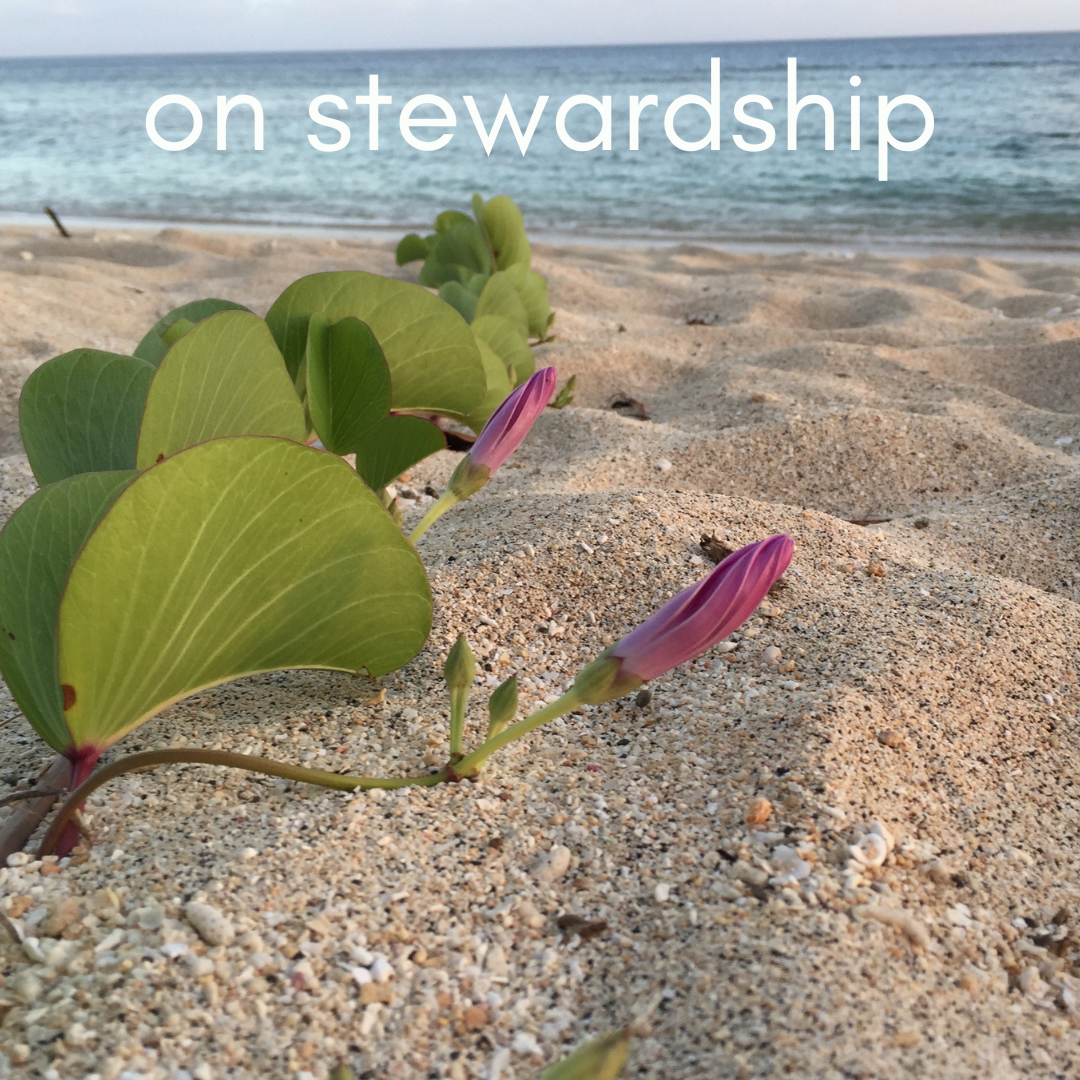
The ideas and actions of stewardship have been an ongoing inquiry for me ever since. I just returned from my annual Dancing the Wild Home Body of Change eco-somatic retreats. I’ve spent a month living on a remote island that is truly in the middle of the South Pacific, surrounded by waters that range in color from azure to teal to seafoam to olive to cobalt to navy. There are uninhabited islands all around, known locally as “whale bone island” or “coconut island.” The inky sky has many more stars than the night sky back home, and the Milky Way is an endless gossamer trail. Breaching, logging, spouting, and tail slapping whales are present for 360 degrees. We rely on solar power and a generator to get a few hours of internet a week. We shower with camping style solar showers. Not so long ago there was no cell service. While the number of bars in our phones are increasing, it’s still delightfully hard to get a signal.
Guests sign an agreement of stewardship: of cleaning up their locally styled accommodation and the beaches. Of preserving water. Of respecting the small but dense wilderness living on this tiny spit of an island surrounded by big blue love. This living in real time, with the sun, with dark skies graced with a still fully visible Milky Way, the constant sound of ocean, wave, wind, seems utterly usual to me. We live so close to earth and ocean that these rhythms, which are our origin rhythms, offer a constant source of connection to the ocean embraced land we are on. I observe retreat participants initially struggle with the slowed down rhythm so intimately connected to the natural world, with the loss of tech and AI driven speedy communication and then begin to dissolve the tensions and demands of these made-up societal rhythms for the completely natural one surrounding and holding us. Rhythms of listening, inquiry and reflection. It becomes impossible to forget our role as stewards of everything that breathes, moves and lives in the environment that so intimately contains us. This reconnection and reclamation into place ushers acceptance of the responsibility of stewardship is the reason for Dancing the Wild Home, and it is an antidote to the utter insanity of the contrived world so many of us live in.
People traveling this far to swim with whales soon learn that it’s not a “sport,” it’s an engagement in a deeper rhythmic relationship that exists in whale time. The whales choose who and when they interact. We practice Continuum, a brilliant moving practice created by Emilie Conrad whose words from her book Life on Land best describe both the purpose and the practice of the work:
“The concert of existence places me in resonance with our biosphere — meaning that at this moment there is no “body,” no separation; I am part of the swirl of bio-morphic unfolding. I feel my breath as one with my world. I am not bound by culture or language. The deepening of sensation allows me to be without category. I transfer the moisture of my cells, join the wet of the grass, the pour of the ocean, the stars that watch over the night. The plants breathe, my skin is wet, we are here. This fundamental umbilical to life without category is for me the first stage of sanity.”
I share a few simple and profound “rules” we all must agree to promote the possibility that everyone joining the retreat embodies stewardship. We never approach the whales, despite the temptation each of us naturally wrestles with when they swim close, gazing into our eyes, extending a pec fin, rolling their bellies upwards towards us like puppies. It’s magic enough to be immersed in the wild shades of ocean, tasting and sensing saltwater on our skin, witnessing our marine mammal kin in their home, open heartedly welcoming us in. We clean the beach of all garbage we find. I collect plastics in an empty duffel to return to a place it will be recycled. Our locally crafted fales often house spiders, geckos and other inhabitants of this island. We learn to identify their night songs so we can just return to sleep when we hear them near us. We coax them along when they take up residence on a blanket or towel or drinking glass. None of them will hurt us, so we don’t injure or destroy them. We all carefully check the beautiful shells we find to be sure no one is living in it. The island is full of hermit crabs whose homes are a panoply of spirals, cylinders, circles, colors, and sacred geometry, from palest blush to bold red and sparkly bronze. One previous participant who coveted a uniquely bright red shell googled how to invite a hermit crab to relocate to another shell if you really want his or her shell. Removing animals from their shells in all the cruel ways humans do it is violence. She tried as researched, by providing two larger options. Those shells were quickly occupied by two other hermit crabs whose shells were too small, and the one she wanted remained in its elegant and vibrantly red shell. She watched them all crawl across the sand to their respective beachfront “property”, willingly letting go of her desire to possess the shell, celebrating the new homes she helped two other crabs find. This respectful act is stewardship.
Stewardship exists in these tiny gestures. We have so much work to do to restore the balance that once existed in our relationship with the natural world that sustains our own life. It can be overwhelming, especially as climate crisis looms, already changing our temperatures, landscapes, and seasons. To engage as earth steward and preserve our energy for caring and tending, and our commitment so that we can keep going, we can begin here, anywhere, with the smallest action.
